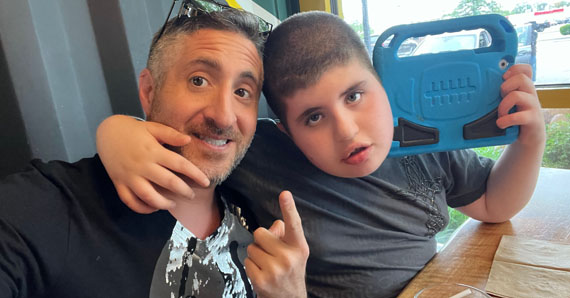
On Monday, I wrote about teaching my non-verbal son to “say thank you.” It’s something that we do in our family. If someone does something nice, we go over and express thanks. We do it, so Lucas does it. He says thanks.
“Say”. It’s a simple word that I use incorrectly all the time according to most people. I realized this when most of the early comments on this post came in. I was confused for a bit.
There were some who commended me for never giving up and how “it will happen someday.” There were others pointing me to similar communication apps that he already uses. Still, some wanted me to know that there were other forms of communication and wondered why I wanted him to say “thank you” when there were more words for my son to say first.
Then I remembered that outside these walls, say means say.
Generally, people hear that word and think of, well, actually hearing that word. What a concept. It means to verbalize one’s thoughts. The entire definition is wrapped around language.

In our home, “say” means a million other things. It means “go tap a shoulder” or “give a hug”. It could be the communication device responding to his tap with a robotic vocalization or even just a hand motion that we’ve come to associate with an action. Regardless of the method, around this family, “say” means “express”.
While I went back and changed some verbage to make the social media post clearer, I found myself pulled back to a time that I haven’t thought about in a while. It was a time when I would have read it the same way so many others did. Say, back then, still meant say.
One of the reasons I started this blog was because, at the time of my son’s diagnosis, I searched for answers. I found very few that spoke to how I was feeling and, when you’re feeling conflicted, the Internet isn’t very helpful.
Stories and opinions online are drastic. People claim that movies either ruined their childhood or saved their souls. To explain something online, many often take a comically strong stance. After all, who wants to read a film review that says, “It’s OK. Go see it yourself. Whatevs.”
Unfortunately, I found many of the same things when it came to some of the special needs parenting blogs. While I only stumbled on a few, the few that I stumbled on didn’t speak to me at all.
So many focused on exhaustion and isolation. I skimmed them with hope that they could offer a point of view other than the one that I feared. Sadly, they didn’t.
For many, it was stories of doom, gloom, and exhaustion. While not just limited to special needs parents, this approach to parental life can be terrifying for newcomers. This was terrifying to me. Most offered no tunnel lights or morals at the end. It was just a glimpse into someone’s hell as I dreaded stepping into mine.
Spoiler alert: I don’t live in hell, although Long Island prices might make it feel that way at times.

We have a happy life and my son, although still nonverbal, is loved beyond words. I’m not begging him in for language in the driveway. I’m begging him to hurry up and get out of the car because it’s raining. That’s about it.
During that time, I would have read a post like mine from earlier this week very differently too. Teaching a non-verbal child to “say thank you” was a huge goal for me. It was everything. Back when Lucas was three, I would have sold my soul for the secret.
Well, dear reader, I’ll give it to you. Do you want to know the secret to getting your non-verbal child to “say thank you”? It’s simple.
Change how you define the word “say”.
When I tell Lucas to say thank you, I am actually asking him to express it. Words are convenient, but far from needed. If you ever had a friend who makes up stories, you know how true that can be. Their mouth might be telling you that they hit the jackpot in Vegas. Their eyes are telling you that they hitchhiked home.
When I ask my son to tell someone “thanks”, I don’t expect a sound to come out of his mouth. I expect him to walk over, put down whatever he’s doing, and show gratitude. How he does it is up to him. High five. Hug or kiss. Tap. Edible Arrangement. Whatever. “Say thank you” simply means “be thankful”.
Does this mean that talking is out of the question? No. Talking is always a priority and I will do whatever I can to help him achieve that milestone, but there are so many others on the agenda too. I want Lucas to verbalize “thank you”, but not without knowing what it means.
My son says hi. He says thank you. He says I love you. Also, he’s never spoken a word. As his father, I know when he expresses these things. I’m just trying to teach him to show the world, as well.
READ NEXT:
FROM AUTISM AWARENESS TO AUTISM ACCEPTANCE TO AUTISM APPRECIATION


 Hi Blog! I'm Dad.
You must be logged in to post a comment.