
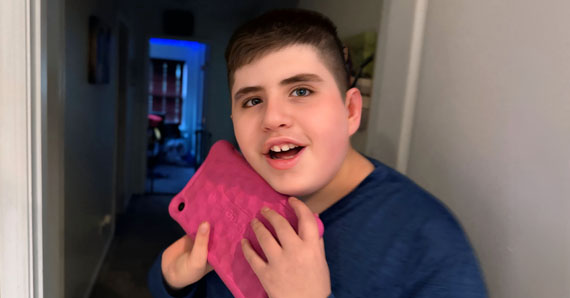
I recently wrote about how my non-verbal son can’t fake a smile. The main idea wasn’t so much about smiles, but about emotions in general. Lucas is purely Lucas in every sense of the word. He doesn’t fake any feelings, from happiness to sadness.
My boy wears his heart on his chewed-up, soggy sleeves. I know when Lucas is happy because he’s openly happy. Observation trumps guesswork when it comes to my son.
Those “feeling the moment” moments spring up out of nowhere too. He’ll go from zero to starving in four seconds and immediately start leading me up the stairs to the kitchen. Tired? He passes right out. You name it, he shows it. There’s nothing false about the straightforward world of my non-verbal son.
That’s something I attribute to his autism. Some may call it a “superpower”, but I’m partial to seeing it as an aspect of his personality we all should try to emulate. Calling it “super” implies that it’s abnormal. It’s not. It’s an inspiration. It’s a way of being that we all can and should aspire to. It’s the cornerstone of Autism Appreciation.
Smiles are always fun to focus on because they contagiously get everyone smiling. Talking about the upsetting emotions could be, well, upsetting. However, they do arise.
My non-verbal son is a 13-year-old and, with many other kids his age, you get times of melodramatic sadness. Tearless crying fits are a norm for many parents to kids off the spectrum. We tell them to “cut it out” and move on. Who has time for that? Not me.
Lucas has no time for that either. Just like he can’t plaster on a smile for a photo, he can’t fake misery for effect. If he’s sad, mad, glad, or anywhere in between, you know it in full color. Unhappy with the day? He’ll plant himself on the ground and set up camp.
It can come out of nowhere too. Reluctantly told to get out of bed so we can get ready for school, he’ll amble up and try to keep swiping YouTube Kids on his iPad while getting dressed. He’s balancing on one foot and clapping as I’m trying to tie his shoes before the bus comes. It’s like being on a game show.
No, Lucas. Focus. No iPad.
I take the tablet from his hands and place it on the bed, face up. It’s a mistake I’ve learned to avoid over the years, but it still happens sometimes. As soon as it’s within view, Lucas becomes fully distracted. He cranes his neck to keep watching the screen while trying to get dressed, stumbling over his pant legs and nearly tearing his shirt in half as he rushes.
That’s when we move to the next phase. That’s the phase where I take the iPad and toss it to the other end of the bed, face down. Lucas doesn’t like that. How much? Well…
You’d expect him let out a small whine, especially since he’s generally a happy little fella. I always do too. That’s what makes the intensity of his emotion all the more surprising every time.
Lucas doesn’t do crocodile tears. Actually, you could call them that because they’re practically the size of crocodiles.
Kneeling on the floor, his balled-up sock in hand and waiting to help him put his foot in, I look up to see them tumbling towards me. It’s the scene from Alice in Wonderland when Alice grew big and began weeping. Only Lucas is starring in this show. Massive droplets of eye water start to splatter around me and, just like the doorknob in Wonderland, I’m worried I might drown.
Initially, my response is stunned surprise. No matter how many times this might happen, I never expect it. As a cynical verbal adult, I question whether it’s real and try to give him a minute to get himself together.
I calmly sit back and look up at my Jolly Green Giant raining down on the Earth below. I might say something like:
OK. Relax. No crying. Come on. You understand what’s going on here. You’ll get it back.
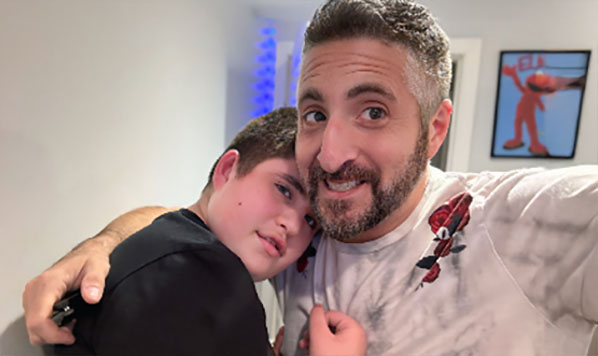
Still, Hurricane Lucas rains down on all below him. So, I’ll stand up and hug him. My heart is breaking and my shirt is drenched. I rub his back, the same way I do during his sensory meltdowns, offer a relaxed tone, and repeat “shhh” a few times. It helps him to reel in the sadness and, within a few seconds, we’re square.
There’s one thing I don’t do, though. I don’t give him the iPad back immediately.
One of the most important rules of parenting a non-verbal child with autism, like mine, is to make sure he doesn’t link a negative behavior with a reward. If he wants a cookie and has a massive tantrum, he can’t have it right away. It doesn’t matter if I was plating it and ready to serve, it gets put back for a few minutes. There’s no other way.
Does it make him sad? Sure. It makes me sad too. Lucas, however, can’t understand subtle explanations. All he sees is tantrum equals cookies. That’s all it takes to set yourself up for a lifetime of teardrops and desserts.
He eventually gets it. In fact, it might be less than a minute later. However, he needs to breathe and calm down first. He needs to see that good behavior garners a reward. That’s on me to show him.
Amazingly, he’s OK with it too. Most kids, on or off the spectrum, are. The tears might be real and his emotions might burn brighter than anyone else I know. Still, I can’t let that be my excuse to teach him the wrong things. Giving in to his demands may make me feel like a good guy in his eyes, but it wouldn’t help him grow to become a good guy in the long term.
And that’s our purpose as parents. I’ll take the heat to make him the best person he’s capable of becoming. We’re chasing that white rabbit into his adulthood together. My job is to make sure he doesn’t lose his head before he gets there.
READ NEXT:
Ignoring Outside Opinions for My Special Needs Son’s Sake
Hear James discuss this post and more on Friday’s Hi Pod! I’m Dad Podcast!
NEW PODCAST EPISODES ARE POSTED EVERY FRIDAY ON HIPODIMDAD.COM!


 Hi Blog! I'm Dad.
You must be logged in to post a comment.