
My 13-year-old non-verbal son doesn’t mess with paper. I’ve rarely seen him interact with a paper product at all.
He doesn’t really like to color or draw. Handing him a pen and asking him to make a mark is usually met with a single line and glare. He appeases me when I ask, but he doesn’t love it.
That goes for any paper in any form – paper towels, paper airplanes, and napkins are all dismissed. Even his school activities take place on tablets or laminated sheets. Seeing my boy with any paper product is a rare sight.
For that reason, his meals are usually pretty bare-bones. I give him a plate with food and a cup. He might get a fork, depending on how finger-like the food is, but that’s about it.
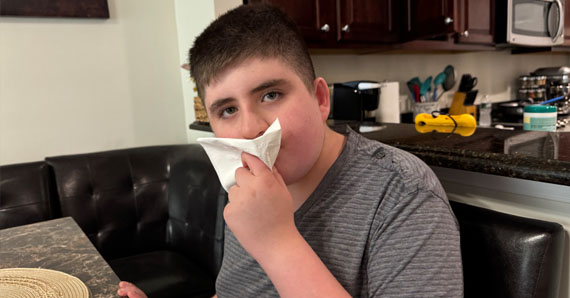
So last week, when I saw him slowly pulling an unused napkin from another spot on the table during lunch, I took notice. Almost covertly, Lucas slowly plucked it with two fingers and brought it to him.
I had to ask, because I seriously had no idea what was coming next.
“Luuuucas,” I called out in a suspicious tone that would annoy me if I were a kid and someone was talking that way to me. “What are you doing with that napkin?”
Again, Lucas’s special needs can affect his limited understanding. So questions like that are often left unanswered. My concern was that he was going to put it in his mouth or something else that he would have done in his younger years.
That was then. This is now. Instead, he looked me dead in the eyes, pursed his little lips together, and dabbed the corners of his mouth like a proper gentleman. I sat stunned. Once again, my non-verbal son made me the speechless one.
How did I teach him that? I didn’t. Where did he learn it? I have no idea.
My guess is that it was taught at school, but that’s never really been on our list of goals. They tell me about the big-picture stuff they work on like making beds and washing dishes. However, things like, “We had him dab his mouth with a napkin like a gentleman” isn’t usually part of our IEP.
Chances are, it came from a larger lesson. They were showing him proper utensil usage or working on patience during mealtimes and, while doing so, had him wipe his mouth with a napkin. They were doing many skills at once and the napkin one was the one that stuck. No one probably realized it and, like so many of Lucas’s emerging skills, it remained with him until he was ready to show us.
This happens regularly and I have seen it happen first-hand with the things I work on with him. A good example is getting ready for school, where there are many different steps along the way.
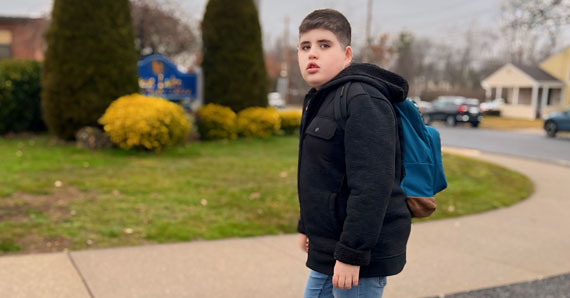
There’s handwashing and tooth brushing and shoelace-tying and so much more. Yet, it was the first time I saw him pick up a deodorant stick, raise his arm, and rub it on himself that I nearly fell over. It was such a small aspect of our overall routine, yet that’s the one that he could do on his own immediately.
Moments like those are what we live for around here. It’s the small steps that lead to the big victories. Not every end goal has to be Earth-shaking. Not every milestone has to be verbal language.
If I’m being honest, his achievements became so much more abundant when spoken language stopped being our dominant focus. The day I accepted that my non-verbal son might never speak with verbal words was the day we started reaching the goals within his capabilities.
When it comes to focusing on different milestones, it’s more about the parent than the child. Lucas has his own potential. Some things he can do right now. Others he can do tomorrow or further down the line. Some he might never do. Those things are true for him, me, and everyone else, whether on or off the autism spectrum.
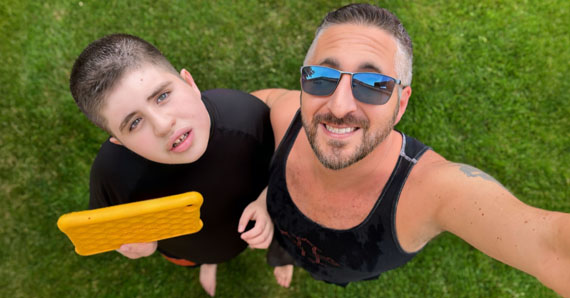
If I, as his father, dug my feet in and insisted on verbal language and only verbal language as our immediate goal, we could be waiting here forever. Whether or not my son ever speaks isn’t solely on me. It’s on both of us, but mostly on him. I can’t dig my feet in, lock the doors, and say, “This weekend, he’s talking! I’m going to work night and day until it happens!”
It might never happen. This isn’t about my ability to teach him and how much work I do. It’s about what’s possible for him right now. That doesn’t mean we don’t work on language. It just means it’s not everything. It’s a part of everything.
On top of that, focusing on one thing mainly or only puts everything else on the backburner. I could have spent the last five years drilling verbal language into him, only to end up with the same level of speech he has now…and nothing else to show for it. No napkin daps. No fist bumps. No hand-washing. No door-holding. Nothing. Just a kid falling short of the only goal his father seems to care about. Neither one of us would be better people from that.
He needs to learn how to be an able-bodied adult. That means so much more than just speaking words. It’s part of our big picture and all the little steps along the way serve as proof that we’re doing things right.
READ NEXT:
My Non-Verbal Son Can’t Fake A Smile
Hear James discuss this post and more on Friday’s Hi Pod! I’m Dad Podcast!
NEW PODCAST EPISODES ARE POSTED EVERY FRIDAY ON HIPODIMDAD.COM!
 Hi Blog! I'm Dad.
You must be logged in to post a comment.