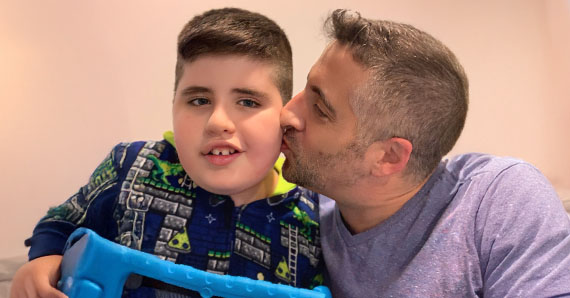
Writing about the early days of my son’s autism diagnosis is sometimes hard. It’s not just that memories of dealing with the reality hit me. It’s that the way I saw things, in retrospect, was just so much more different than they are today.
Few people realize that you don’t find out your toddler is going to be non-verbal via blood test, zodiac sign, or carrier pigeon. There’s no official pronouncement or moment of truth. No one even used that term until Lucas was older.
That’s because realizing your child is non-verbal happens through waiting…and waiting…and waiting on that first word. It’s supposed to be the next step in a process that starts in infancy.
It’s the age of firsts. There are initial steps, crawls, and rolls for your little bundle of joy. Baby books and endless Google searches map out exactly when these moments should happen.
For Lucas, these firsts came with delays. He didn’t do a lot of the physical milestones at the same pace that we expected. Still, they eventually happened. When people asked, we told them he was delayed. It seemed right.
When it came to language, though, there wasn’t a delay. There was silence. No words. No imitations or attempts. It was as if he didn’t understand the concept at all.

He made sounds. Those baby babbles filled our home, but they didn’t resemble speech. They were expressions of joy or excitement. He’d breathlessly howl when playing with his toys or looking at reflections. The noises Lucas made weren’t done to communicate. They were done as outlets of emotion.
In the absence of words, it was hard to focus on anything else. Teachers and professionals would ask what goals to focus on for Lucas and all of our answers were “language.”
Each person would then acknowledge that request and follow up with the go-to:
What else should we work on?
And, again I’d say language.
At the time, I’d think that it was the most ridiculous question on Earth. “What else?” My three year old doesn’t say Da-Da. What else is there to need?
To me, it felt like a waiter asking you if you wanted anything else as the restaurant is engulfed in flames around you. It’s like, “No, dude. Put out the fire first and then we’ll talk.” No one understands urgency?
Still, after a little while, I stopped making that the end-all, be-all when it came to goals for my son. It killed me to do so, but I knew it was the only option. I can’t bring his education to a grinding halt until he says his first word. What if he never does?
Now that my son is a teenager and still, as of now, hasn’t spoken, I’m grateful to myself for eventually giving in. I think about all that my boy would have missed out on otherwise.
From self-care to receptive language to simply showing love, there were so many things that my son needed to learn. Verbal language, while incredibly important, wasn’t the only thing.
In fact – and this is the statement that took me a decade to fully appreciate – it’s not even the most important thing.
Had I known a decade ago that I’d be writing that sentence today, I wouldn’t believe it. That’s because I was so caught up in the idea that spoken words were the key to everything – understanding, connection, and success. I thought that without them, the world would be closed off to my son and that he’d be lost in it.
But then, slowly, I started to see the truth.
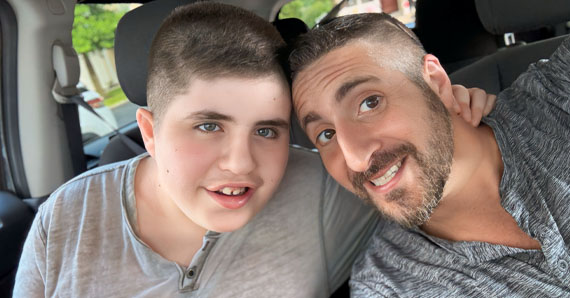
I saw it in the way he pulled my hand toward what he wanted. I saw it in the way his eyes lit up when he was excited, or the way his body tensed when he was overwhelmed. I saw it in the gentle ways he showed love, like resting his head on my shoulder or taking my hand just because he wanted to.
I had been waiting for words to fill in the blanks, but they were never blanks to begin with. Lucas was always communicating. He was just doing it in ways I hadn’t learned to listen to yet.
Verbal speech is valuable, no doubt. But connection? Understanding? Love? Those things don’t require it. And when I finally let go of my desperation for words, I realized that my son and I were speaking the same language all along.
Does that mean language is off the table? Not at all. Even now, I work on helping him imitate words and sounds. Can he do it? I think so. Will he ever? I don’t know. But does it matter? Not nearly as much as I once believed.
There are no words to describe the love I have for my son – and no words needed to feel it.
READ NEXT:
My Non-Verbal Son is 13, Not “Mentally 6” – Here’s Why That Matters
PREORDER JAMES GUTTMAN’S NEW BOOK –
Hi World, I’m Dad: How Fathers Can Journey to Autism Awareness, Acceptance, and Appreciation https://amzn.to/3FmBWov
Hear James discuss this post and more on Friday’s Hi Pod! I’m Dad Podcast!
NEW PODCAST EPISODES ARE POSTED EVERY FRIDAY ON HIPODIMDAD.COM!
 Hi Blog! I'm Dad.
You must be logged in to post a comment.