
📘 My New Book Is Here
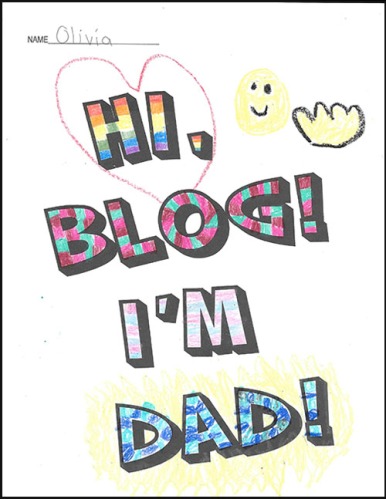
“Hi World, I’m Dad” is now available for pre-order! It’s all about fatherhood, autism, and everything in between.
👉 Click here to get it on Amazon
When people hear that my son is non-verbal with autism, they make a lot of assumptions. Some are true, some are false, and others land somewhere in between.
The most common misconception is that having a 14-year-old who has no words and pronounced delays or disabilities must mean a lack of communication, understanding, or love. Based on shows they’ve seen or stories they’ve heard, they assume that my son is just another item on my list of responsibilities, and not much more.
Of course, if you’ve read anything I’ve ever written, you know that’s not true. There are fatal flaws in that thinking, even if a few points sound reasonable on the surface.
Is communication different? Yes. Lucas can’t get off the school bus and say, “Wow. What a day. The bus stinks. I need a cookie.” That much is obvious.
Then again, many people don’t do that…even if they can speak. I’ve sat in silence on car rides with my neurotypical daughter, having no idea why we’re being quiet. When I finally ask, she’ll say something like “I’m tired,” or just, “I’m not!”
What Lucas does instead is something I’ll never take for granted. He’ll come down the stairs, walk straight up to me, wrap his arms around my neck, and rest his head on my chest. It’s one of his signature moves and easily one of the most heartwarming things I’ve ever experienced.

If I try to move before he’s done, he plants his feet and gently pulls me back. That hug, in its stillness and sincerity, tells me everything I need to know about his day. And I get to experience that every week or two.
Meanwhile, there have been people who have been in my life with vast vocabularies who never understand, much less explain, how they’re feeling. They never tear down their walls. Lucas doesn’t have walls. Lucas is Lucas.
He knows how he feels, and he knows how to show me. He might not have words, but he doesn’t need them. He’s fluent in emotion.
And when it comes to emotion, no one feels things more deeply than Lucas.
That’s why I don’t get upset when he does something wrong by accident. Spill a drink. Drop his lunch. Lay down in the bathtub with the shower curtain tucked under him…sending it crashing to the floor in a wet, splashy disaster. These things happen. And yes, they can be maddening.
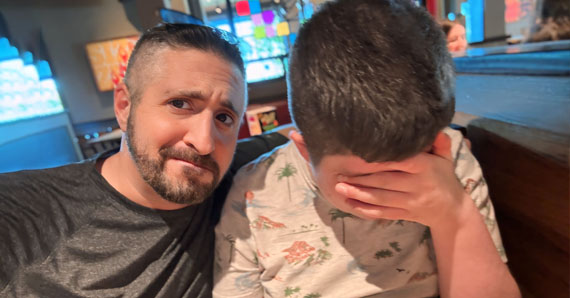
But if I so much as raise my voice during those moments, even a little, his reaction is immediate and intense. The tears come pouring out. I’m talking real, heart-wrenching tears. It reminds me of that moment in Alice in Wonderland when she cries so much she floods the little room with the tiny door.
That’s my boy.
But if he does something on purpose, like steal someone’s lunch from the fridge or yank out his charging iPad when I’ve told him “no”, it’s a completely different story. He doesn’t melt down. He stands there, calm and quiet, wagging his finger in a “no, no, no” motion to show he understands.
He knows the difference between being unfairly scolded and being rightfully corrected. That’s an abstract concept I never expected him to grasp. To be honest, I didn’t fully realize he had until writing this just now.
When Lucas is happy, he’s the happiest person you’ll ever meet. When he’s sad, it’s Niagara Falls, Frankie Angel. He taps into his feelings in a way many of us can’t even fathom.
I know this because I’ve met so many people who have no idea what they’re feeling or why they feel it. Neurotypical people, with all the words in the world, often struggle far more with their emotions than my son, who’s labeled as having a disability.
Lucas is the most refreshing presence in my life. In the half-week when he’s not with me, I find myself slipping back into a world of trying to decode motives and read between the lines. It can be exhausting.
Then comes the day Lucas returns home. I meet him at the bus. He walks down the steps. And I get that hug I’ve been waiting for.
Suddenly, the world makes sense again.
Typical people might not understand my son, but I do. In fact, I understand him better than I understand most typical people. His lack of words doesn’t close him off. If anything, it opens him up. He doesn’t hide behind language. He doesn’t manipulate with words. He doesn’t gaslight or pretend he meant something else.
My son is unapologetically himself.
It’s an approach to life I admire and one that flips every false assumption on its head.
That’s why I’m not trying to “cure” him, change him, or force him to fit a mold that isn’t his. I accept my son. I appreciate him. Every single day.
And if you knew him, you would too.
READ NEXT:
My Non-Verbal Son is A Teenager, Not “Mentally 6” – Here’s Why That Matters
PREORDER JAMES GUTTMAN’S NEW BOOK –
Hi World, I’m Dad: How Fathers Can Journey to Autism Awareness, Acceptance, and Appreciation
Hear James discuss this post and more on Friday’s Hi Pod! I’m Dad Podcast!

NEW PODCAST EPISODES ARE POSTED EVERY FRIDAY ON HIPODIMDAD.COM!
 Hi Blog! I'm Dad.
You must be logged in to post a comment.