

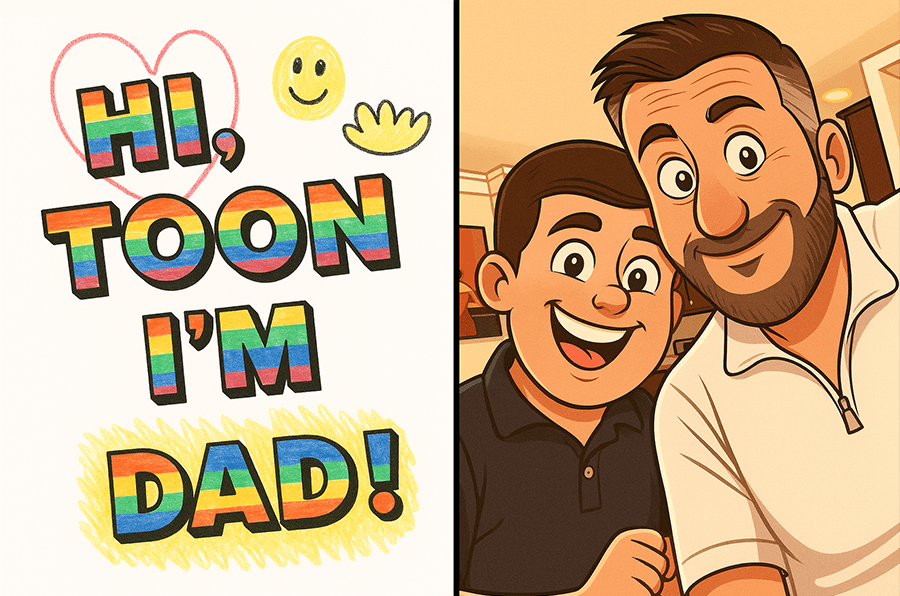
Our new series “Hi Toon! I’m Dad” is now live.
Scroll down to see an 11-minute compilation episode and follow on
TikTok, YouTube, Instagram – all @HiJamesGuttman

LISTEN TO THE FREE PREVIEW BELOW ON SPOTIFY:
In another life, Lucas was a linebacker. No one can plant like my boy.
This immovable object approach to life takes on a few different forms for my son. Lately, he’s been doing the stand-still-and-stare technique.
That’s when I’ll have his hand and start walking, only for him to root his feet and go full statue. He becomes one of those little coiled door stops and, as I pull on his hand, I find myself jerked back with a boing.
Perhaps the easiest of his approaches to break through, the door-stop motion is solved easily. You let go of his hand and keep walking. After a few feet, he comes trotting up beside me. I learned long ago that it’s about doing it on his terms, not about refusing to go further.
This is a step beyond the hug-and-hold method.

This method is exactly as it sounds. Struggling with an emotional overload, he’ll wrap his hands around my neck for a hug and do the familiar planting stance. It’s like the door-stop move, only now I’m stuck in it with him.
Truth be told, this is my favorite planting technique. It’s sweet and, when people see it, they offer smiles and caring expressions. Even if it’s an inconvenient spot, everyone notices the beauty of how he’s dealing with his anxiety. The whole thing is adorable.
Those two things are easily handled, and most of you reading this don’t have any questions about how you’d handle those situations. In both cases, you’d probably do the same thing I did.
Then there’s the granddaddy of them all, the oppositional stance that rules them all.
Wherever, whenever we’re out together, Lucas will sit down and refuse to move when the mood strikes.

I know many neurotypical parents have dealt with this too. Sure, your kid may have been younger, but you know about children lying on the floor when you’re in line at the bank or supermarket. Wanting a rest is part of parenting.
Well, take that scene and transpose it into a much more dangerous place. Picture crowded train stations and manic playgrounds. There’s a reason I can’t take this kid to a bouncy-trampoline-place or let him into a bouncy house. That’s where it all began.
He was maybe three the first time he planked in a giant rubber castle. As kids hopped around him, I pictured his little head splattered like a smiling egg. Rushing in to save him while being jostled up and down by a parade of hopping children was a scene straight out of a zero-gravity disaster movie.
I looked ridiculous. That’s what I try to remember when dealing with it now.
When people hear that I sit down next to him during these trying times, they’re surprised. If my boy drops to the floor in a store and won’t get up, I sit next to him in a show of support. I rub his back and tell him things will be OK in a soothing voice. Eventually, he gets up on his own, and he’s calm when he does.
How do people act? Fine. They walk around us. In all the times this has happened, no one has ever said anything to us. Frankly, I don’t pay attention to other people in that moment.
If this sounds like a crazy option to take as a parent, I offer you the alternative.
Before I learned that joining him in the sit-down protest would make it end on a better note, I tried everything you would have.
I’d try to reason with him, using words he doesn’t seem to understand. People would watch me talk at a kid who didn’t seem to care.
I’d try to grab his hand and pull him up. At best, he would let his body go limp and I’d be spinning him around in circles by his wrist. It was like a little tornado in the foyer of Target.
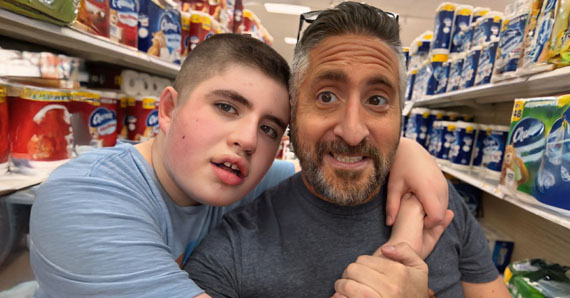
I’d try walking away and doing the whole, “Bye, Lucas. We’re going to go.” He’d stay there, defying me to abandon him in public like Punky Brewster. I’d always come running back.
The point I’m making here is that the thing I do, which seems like it would be embarrassing or disruptive, is literally neither. In fact, it’s the least obtrusive and humiliating of any approach I could have taken. Best of all, it puts my son first and shows him that I love him.
Right there is the thing that sets it apart from the other techniques. People see this over-the-top care for my kid over anyone else and they respect it. They assume I know what I’m doing and they give us space. No one is complaining about the kid with autism sitting on the floor because they can see that his dad is taking care of it. In fact, my response is so off the beaten path that they assume I must know what I’m doing.
Which I kind of do.
Of course, in times of danger or urgency, I give him the old double arm-underhook wrestling move like a Brisco brother and pull him to his feet. But I don’t want him to think that he only has to stand when physically forced. Lucas needs to learn what’s right, rather than be forced to do it.
My goal is to teach my son to regulate his emotions and deal with overwhelming moments in a healthy way. When he sits, I know he’s trying to do that. Can it be frustrating for me? Sure. Is it frustrating for him? Definitely.
So I sit with him, because sometimes support means not rushing the moment.
In another life, Lucas was a linebacker. No one can plant like my boy. But in this life, in our life, he’s a boy learning how to cope with a world that doesn’t always make sense.
And I’m the dad learning to kneel beside him instead of pulling him to his feet. Because sometimes the best way to move forward is to sit still first.
READ NEXT:
Raising an Autism Sibling Bond Built on Love, Not Obligation
Looking For a Speaker?
Book James Guttman Here.
Hi WORLD I’M DAD: How FaTHERS CAN JOURNEY FROM AUTISM AWARENESS TO ACCEPTANCE TO APPRECIATION
Audio – Digital – Paperback Available…Everywhere.
Get It On Amazon – Get It On Audible – Get It On Spotify – Get It On Barnes & Noble
 Hi Blog! I'm Dad.
You must be logged in to post a comment.