
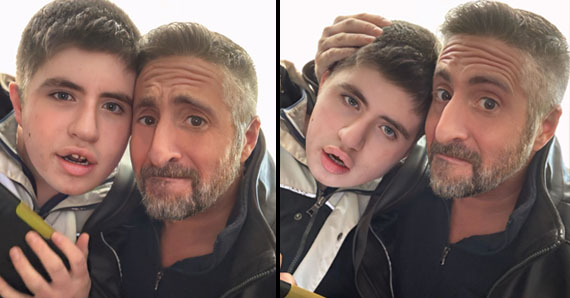
My writing, my passion, and my life center on Autism Appreciation. I define it as finding beauty in my son’s personality because of, not despite, autism.
Some people love it. Some people don’t. I’ve debated my point of view with many who are in a similar situation. Ultimately, I agree to disagree. There’s a reason for that.
Autism Appreciation has more to do with me than it does with my boy.
I realize that line requires an explanation. For most, they assume that Lucas is a happy person who requires little work. I’ve gotten emails from some with laundry lists of chores that “many parents have to do for their children with autism.” To them, it feels like a gotcha.
The only gotcha they get is a reply from me. Yes. I got you. I hear you. I understand. That’s because all of the items they list are things that I do for my son.
Lucas has profound autism. Nearly every task you can imagine requires help on my part. I use the term “tying his shoes,” but it stretches far beyond that. I do nearly everything for him.
Is it easy? No. Is his autism a part of that? Yes.
Do I hate his autism for it? No.
That’s because I see the unique ways he sees the world because of it. I appreciate who he is, and I envy how uninhibited he is by the social restraints we all put on ourselves.
If Lucas is happy, he will jump in the air and scream with delight. He doesn’t care who is looking or where we are. If he’s tired, he will sit on the floor. If he’s sad, he’ll cry. When he gives you a hug, he wants to. There’s nothing fake about my kid.
I say this is about me because all of these things exist together. The hardships are there, just as the purity of his emotions are. The difference is that I put a higher value on the beautiful aspects of his personality than the chores he requires me to do.
And that’s me. Maybe it was the sudden heart surgery I had in 2012. Maybe it’s my desire to be a better parent than I ever knew. Maybe it’s how I was born. Either way, I would rather admire my children than spend my time wishing they were different.
I say children because I have two. Olivia, my daughter, is a neurotypical 17-year-old. She is a smart and beautiful girl who has so much potential I can’t even process it. There’s no limit to who she can be or what she can do. She makes me a better person by simply being in this world.
She’s also a responsibility. I worry about her every time she leaves the house and do whatever I can to make sure I can be the father she needs. Any parent knows how much work it takes to not let your kid down. That’s a part of my everyday.
Yet, I don’t spend my time wishing she was someone else. You take the tasks with pride and find balance. You focus on what you love rather than what you need to do. Most parents of neurotypical kids know how to do that.
For some reason, though, those with kids like Lucas tend to focus on the hardships. After all, that’s what the world expects. They see me with him in public and silently bow their head, sending thoughts and prayers on social media. They see the deficits before the positives.
I don’t. I’m not wired that way.
Some will read these blogs, look at our videos, and think that I’m lucky because my son seems so jovial. He is. Lucas, for the most part, has a positive attitude when he’s with me.
The unexpected twist is that I believe my attitude is what allows him to be that way. The kid he is when he’s by my side is a product of how I treat him.
I don’t freak out on him and trust me, there were many moments that might warrant it. Even during our most trying times, I keep my cool. I look at the world through his lens.
Is it frustrating when he does something wrong or creates an issue that I need to clean up? Absolutely. Do I know that he has autism and didn’t do it on purpose? Yes, I do.
Because of that, I don’t yell at him or make a production. Sure, he might get a stern voice and a wagged finger that I make him mirror back, but there’s no screaming. There’s no heightened tension. There’s understanding, and there’s calm.
That’s why he is who he is, and that’s what allows me the luxury of seeing his best qualities on display. Lucas knows he can be himself with me and that even his missteps won’t send me into a spiral. He is accepted, and I know, in my heart, he feels that.
Often, I say that if the world’s worst waiter serves you the world’s best pasta, which part do you lead with when telling the story? I start with the pasta. Sure, I’ll tell you about the waiter, but I won’t focus on it. I don’t let it ruin my experience.
The same can be said for the work that comes with parenting my boy. It exists, but it’s not the lead story. If anything, it’s an understood and distant chapter. It’s simply a footnote in my story of Autism Appreciation.
If this story resonated with you, I talk more about topics like these on
Hi Pod! I’m Dad.
READ NEXT: Why Trust Matters More Than Understanding With My Nonverbal Son
Looking for a speaker who talks about parenting, connection, and reframing expectations?
You can book James Guttman here.
 Hi Blog! I'm Dad.