People like to tell each other a lot of things. What they think. What they like. What they believe you want to hear.
When my son was first diagnosed with autism, and it started to become clear that he might be non-verbal, that was the one thing I couldn’t stop thinking about. How could I have a relationship with someone who couldn’t tell me anything?
To me, words were the key to communication. Every relationship I’d ever had with anyone was wrapped up in them. Some were sweet. Some were not. Sometimes you had to keep track of what you said, what they said, and what any of it actually meant.
And, to be honest, I hate that.
We talk in circles, and there’s nothing more maddening than a three-hour conversation that lands you right back where you started.
That’s because I’ve learned, as I’ve gotten older, that words don’t really explain much. Sure, they come in handy, but they can often be shields for pure emotions.
Whether it’s listening to a friend trash someone on a Tuesday and seeing them love that person’s Facebook profile pic on Wednesday or just telling you they cherished your present, only to find out they returned it, the truth is rarely in the things that we speak. They’re in the things that we do.
And my non-verbal son is an expert in that. His actions speak louder than words because actions are all he has.
Don’t get me wrong, Lucas has a communication device which he mainly uses to order me to make quesadillas. We have gestures and movements that coincide with words like “stop” and “more”. He has ways of getting his point across. Words stretch beyond verbal language.
He doesn’t, however, use it to tell me his feelings, emotions, or loves. That’s because he doesn’t need to.
Let me give you an example of what I mean. A verbal person comes to my home. They’re happy to be here and they tell me. They might remark on the décor or cleanliness. They smile politely and thank me for having them over. It’s a pleasant visit. We have tea and Little Debbie’s cakes. It’s a whole thing.
They get their point across but it’s muted and subtle. Sure, they’re happy to come by, but it’s not life-changing. I smile. They smile. We all smile.
On top of that, for many, there’s a chance they’re not happy to be there. Maybe you hear from a mutual friend later on that week that they said otherwise outside your presence. Perhaps they, themselves, shout at you a week later, claiming, “You made me come over!” Words are only as good as the person saying them.
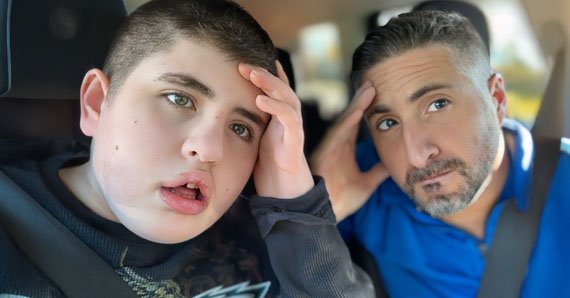
Contrast that with Lucas, my 14-year-old non-verbal boy. This past week, when he was dropped off at my house, I saw it first-hand. The moment that he walked in, I knew he was happy to be here. You know how I knew?
Because he was literally jumping in the air, screaming, and clapping. It was over-the-top. Imagine I was a Beatle and he was a girl in a black-and-white video reel freaking out. I felt like a celebrity. He was over-the-moon and there was no denying it. I saw it with my own eyes.
That’s what he’s like in the morning when I get him up. That’s what he’s like when he gets his iPad after a long day at school. That’s what he’s like when I pour him a bowl of cheese puffs. Lucas celebrates life. Lucas never makes you guess.
Not only does he wear his emotions on his sleeve, but he never fakes them. If Lucas is happy, he’s the happiest boy in the world. If Lucas is upset, he shows you that too. What he likes, he likes. What he doesn’t, he doesn’t. He shows you in his actions.
He reads energy. There are people he knows for five minutes that he will give a huge kiss on the cheek to. Then there are people who were around for what-felt-like forever who were lucky to get his head on their shoulder. Whether food, toys, or humans, Lucas is open about what he likes best.
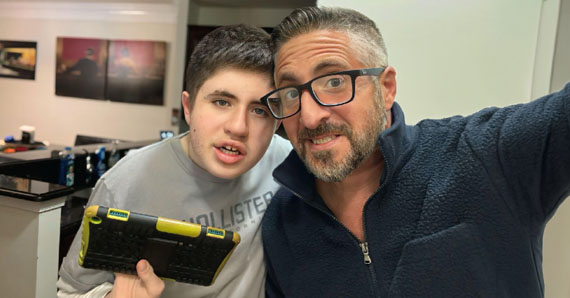
He can’t fake a smile either. Every grinning picture of my boy is genuine. It comes across in pictures and it comes across in life. He’s the most honest person I’ve ever known and the easiest to understand.
There’s an irony to that statement in the truest definition of the word. It is literally the exact opposite of what I would have imagined by this age. To know that my son, who can’t articulate a single word, is easier to connect to than someone with a dictionary of redirections is both obvious and mind-blowing. I wish I realized it when he was little and I stayed up worrying about it.
It took a while, but I know there’s nothing to worry about. Words are overrated and actions are what’s most important. To that end, my boy has the foundations of communication all figured out. Save your words. We don’t need ‘em.
Looking for a speaker who talks about parenting, connection, and reframing expectations?
You can book James Guttman here.
If this story resonated with you, I talk more about topics like these on
Hi Pod! I’m Dad.
READ NEXT: Why Trust Matters More Than Understanding With My Nonverbal Son
 Hi Blog! I'm Dad.
You must be logged in to post a comment.