

When the idea first came up, I didn’t want to introduce a communication device to my son. I watched as he struggled with language. My belief was that allowing him to use it would hinder his desire to use real words.
It sounds silly to say aloud now. Years later, I know how that tablet is his lifeline to the world. Those who don’t understand his mannerisms as I do wouldn’t have any other way of comprehending his needs. I can’t even imagine how he’d live today without it.
I’m proud of him for how he uses it too. Lucas will come to me with an anxious expression and start trying to maneuver me toward the kitchen by hand. Rather than allowing him to lead me to his wants, I give him over his device, so he can tell me.
This kid is amazing when it comes to navigating that thing. At breakneck speed, he goes through each menu before settling on his request, tapping out the words, and then making eye contact to verify that I understand. When I acknowledge him, he does the same thing every time. He exits the submenu he’s in and returns it to the main screen. That’s his thing. If he had words, he’d probably say that leaving his communication on the submenu is his pet peeve. It makes me smile.
So yeah. Hip hop hooray for his device, but the question remains. Has using it hindered his speech? Is this concern, faced by so many worried parents, one that is realistic?
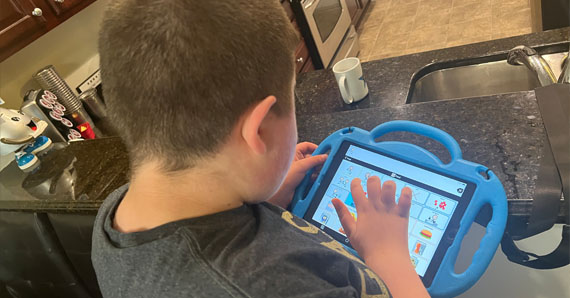
I can’t answer for other kids, but I can for my own to an extent. The device has given Lucas an outlet to communicate when he had no other. Is it convenient for him? Sure. However, I highly doubt that he has the ability to speak but figures this is easier. In fact, I know that’s not the case. I know that he needs this device.
How do I know? I know because I’ve never given up teaching him to speak. Even now, at 12 years old, we still work on his words regularly.
For the most part, it’s been touch and go. Throughout his life, Lucas would never imitate sounds or mouth movements. I’m not really sure why. I’d ask him to say “hi” and his response always made me sad. He’d begin pointing to and tapping on his mouth before becoming agitated. Seeing this, I would stop the attempt. The last thing I wanted to do was upset him, especially as it related to possible speech.
This literally went on for years. Physical movements were no problem. Fist bumps and hands raised were easy to teach. Mouth movements – even as simple as blowing air – were always met with opposition and a frustrated physical reply.
Until this past week.
I noticed that he had begun moving his mouth more. It had been a while since we really worked on words, so I sat him down and tried again.
Lucas. Look. Look at me. Say “Hhhhhaaaaaaa-ai”
That’s not a typo. I’d have him do the hard-H sound and, as the air is coming out, turn up the “i” sound at the end. It is pronounced the same way it’s spelled. He has done the hard-H sound in the past. I knew it was possible. So I tried, as I had so many times before, to get him to mimic me.
The difference now is that he wasn’t just staring at me anymore. There was no touching of the mouth or agitation. Instead, he did something that I never saw him do and something I didn’t expect.
My little guy opened his mouth to vocalize the H sound. As he did, he’d lean his head back, squint his eyes, and make this deep throaty noise. It almost sounded like he was gagging, and it made him cough.
I have no idea why this is or what part of his vocal cords he is trying to access. Regardless, he’s trying. For the first time in, well ever, he’s trying to repeat a word. It blew me away. A week later, it still does.
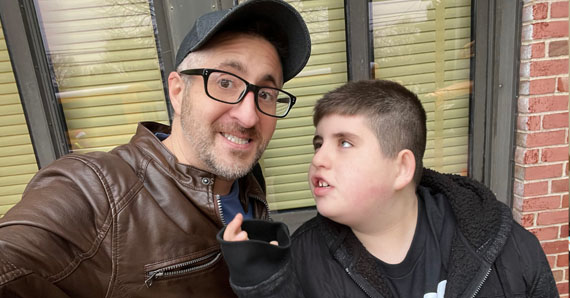
Not only is he trying, but he’s giving slight insight into why the process has been such an issue. Is he trying to tap into muscles to talk that he shouldn’t be? Is there an issue with how he’s going about it? Is there a missing piece we can figure out together and get him babbling?
While none of those answers are known just yet, they will be. It’s a big deal and there’s only one reason why this is all happening.
It’s happening because we never gave up.
The autism diagnosis didn’t end my attempts to help him speak. The device didn’t stop our tries. The shrugs and lowered expectations of professionals didn’t close the doors on language. Nothing did. We kept trying the whole time.
Will he definitely do it? Who knows. That’s not really the point. It’s about seeing if he can. Not achieving language isn’t a failure. Giving up because it seems hard or unlikely would be.
Besides, what else are we going to do? We have a lifetime together. Even when it seemed like he could never do it, we tried. That’s what family does.
If it was me who was struggling to learn something, I’d want people to help me, even when it seemed I couldn’t do it. I’d someone to believe in me the same way I believe in him.
And believe in him I do. My boy is my everything and no matter how far away we seem from achieving great things, we’ll never stop trying to reach them. The only way a device will hinder him from speaking is if we stop trying to get him to speak. The only way he’ll stop learning is if I stop teaching.
So, I won’t. I’m here for the long haul. He is too. There’s no limit to what my son can do. Neither of us is giving up.
READ NEXT:
MY NON-VERBAL SON WAS ONCE MY BIGGEST UNKNOWN, NOW HE’S MY CONSTANT

 Hi Blog! I'm Dad.
You must be logged in to post a comment.