
People hear that my son is non-verbal and they immediately begin thinking of all the challenges that come with it. I wish they would imagine the joy he brings into our world first, but I understand why the mind drifts elsewhere. That’s why I focus so much on showing them how wonderful he is.
I do, however, try to be understanding of their perspectives. While I have had 12 years to be around my son, I still try to remember life before him. What would I think if I met someone then who is in my position now? What would I think first about the challenges that raising a boy like him brings?
Where do you start? That’s probably my biggest question. After all, there’s a whole world of things to teach a child, regardless of whether they are on the autism spectrum or not. How do you begin to tackle parenting a kid without them having the ability to repeat back what they understand or even, at times, acknowledge that you are there? Where do you begin? How do you begin? What’s the most important lesson?

Communication? Sure. That’s a big deal. But you can’t really teach that in a grand sweeping motion. Learning communication isn’t like learning your ABCs. It’s a long-term process that, even for those who are verbal, never ends. Between receptive language, hand motions, device management, and a slew of other ways to express one’s needs, this is a big-picture thing. It’s a process. Surprisingly, the most important lesson is not communication.
Life skills? That one’s a big one too. Again, though, that’s a laundry list of learning activities. It’s not one and done and you don’t knock it out in an afternoon. That too is a slow process and learning life skills won’t bring about the ability to tackle other lessons afterward.
At this point, I can go on starting paragraphs with a word followed by a question mark and then explain why it’s not important, but that’s getting old. I’ll just cut to the chase. There’s one specific thing I needed to teach my son first. Without it, teaching these other lessons would be far more difficult.
I needed to teach him that I love him.
Sound corny? If so, you’re reading it wrong because I don’t mean it in Hallmark way. I get that it comes off that way, though. Alas, the love of a father is the wind which lifts a child’s wings to soar. That sounds good, right? Put it on a black-and-white picture of a bird. Share it with your friends. Like and subscribe. All the feels. You get the deal.
While that is a beautiful part of it, I’m saying this in a more practical sense. My non-verbal son knowing I love him is most important because of the fact that everything he needs to learn from me requires a leap of faith. If he doesn’t trust that everything I try to teach him is for his own good, he would never trust me to follow my lead. When there’s a clog in our communication, that’s the only way to put him at ease in the face of the unknown.
Think about it. Putting him on a school bus would be a nightmare. Getting him in and out of a car to go to an activity that I can’t explain to him beforehand would be impossible. Walking him into a new building, taking away his toy so he can get dressed, and even the simple act of waiting for food to cook would be agonizing. Life would be full of meltdowns. If my son had any doubt as to my intentions, every step of our lives would be tumultuous. We would be rolling a boulder uphill until the day I keel over.
Long before the idea of autism ever entered our lives, I taught Lucas that I loved him. As an infant, I would say “Who does Daddy love?” Then, I’d take his tiny little hand, make him tap his own chest, and screech, “Meeee!” in a shrill voice. It was just a thing I did. I thought it was cute. I never realized how important it would be.
As he grew, he started laughing when I did it. Then, as he grew some more, he started tapping his chest himself. Today, we still do it. I always laugh at the serious face he makes when he taps himself to acknowledge that – yes – Daddy loves him.
Full disclosure. There have been times when I worry that this is more of a parlor trick. I don’t want him simply mimicking. I want him to know what love truly is. We may have gestures for it, but still, does he really know? This seems like a small expression of a big-picture concept that might be out of his realm of understanding.
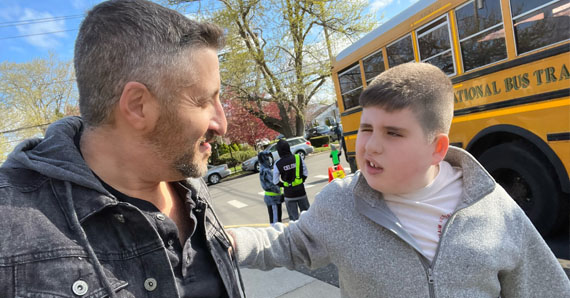
Truth be told, he does. He knows I love him. I know he knows it too. I’m not just saying that. It’s something I worked hard to do far beyond a screeching “me”.
I always showed Lucas love, even when I didn’t know if he was noticing. I did when he was an infant. As he got older and we started to notice his delays that made me fear he would never interact with me, I did. I just never stopped. He didn’t have to look up or even show that he realized I was in the room. Just because he didn’t seem to register my affection or presence at certain points in his life, I still talked to him and gave him the same love I would give him otherwise.
I didn’t just do it for him. I did it for me. He’s my boy. I love him. Just as you don’t say hello just to get one back, you don’t show love just to get it back. I knew his personality was emerging and that one day, he might be able to return those feelings to others.
Today, he does just that. He hugs. He kisses. He smiles when I come into the room and brings me over to sit by him while he plays on his iPad. All things that were a pipe dream ten years ago are realities now. There’s no doubt in my mind that this kid has registered it all and knows what it means to be in a family. There’s also no doubt that if I hadn’t expressed myself to him during those more distant years, he wouldn’t be the boy he is now.
We build on that foundation every day. The security he has in our relationship allows me to teach him important, and sometimes abstract, life lessons that he might be apprehensive about from someone else. It took a while, but I earned trust, just as he learned trust. Today, I can proudly say that I taught one of the most important people in my life one of the most important lessons in his life.
I love that I did.
READ NEXT:
FROM AUTISM AWARENESS TO AUTISM ACCEPTANCE TO AUTISM APPRECIATION

 Hi Blog! I'm Dad.
You must be logged in to post a comment.