

When you have a baby, there are some crazy worries that go through your head.
The day I took my daughter home from the hospital bugged me out. I couldn’t fathom how they just let me take this fragile little being and drive her away. There were no instructions or people coming to supervise us for a year. It was just a pat on the back, a complimentary blanket, and a “ya’ll make sure you keep her alive, ya hear?”
Once you unwrap those newborn concerns, other ones spring up. How would she learn language? Forget words like cookie or Wiggles. How would I instruct her about abstract concepts like love or the word “is”? Weird, right? No one asks that. I’m supposed to teach another person to conjugate verbs? Is that even a thing in English? Conjugate? Do we call it that? I’m not even sure what we refer to it as, how am I supposed to teach it?
Good news all around. She’s 15 now and she gets the verb and love thing. How? I don’t know. It just happened. Most parents to neurotypical children can relate. It just happens. No one gives you a medal for it.
Her little brother, however, was a different case of concern altogether. Lucas is three years her junior and, as of this past 12th birthday, he’s non-verbal. In his case, the verbs haven’t really been an issue that needed to be addressed.
Concepts like love and care are still pretty important, though. With a boy like mine, his autism pretty pronounced in terms of his overall understanding, worries about whether I could teach him these abstract concepts were grounded in reality. I genuinely didn’t know if I could.
Think about it. This went beyond a new dad’s silly worries. This was a real issue. How do I teach Lucas “love”? Is that even possible?
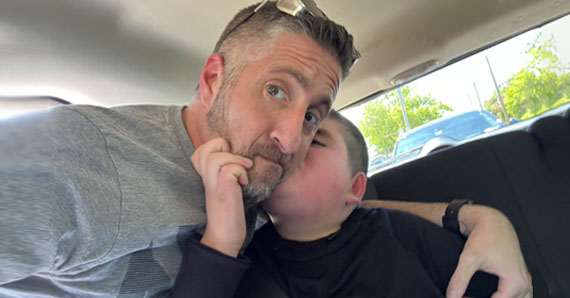
Hollywood told me it wouldn’t happen. Movies always made sure to show me that the real way that autism acceptance happens is when a person with autism scores a touchdown in our world. Once he or she does, the person who believed in them runs over for a celebratory hug. From there, we get an awkward backing away and a reminder that people with autism don’t “get” love. How sad. No love. This is who your kid is going to be. Enjoy the popcorn.
Well, with all apologies to Dustin Hoffman, that’s garbage. To say that people with autism don’t know love is like saying that people in wheelchairs don’t wear shoes. I mean, they might not wear shoes, but that depends on the person. All people don’t do all things. We’re individuals, no matter how hard we want to put each other into categorized boxes.
I wrote about teaching Lucas motions to emote love, in the absence of words. He hugs himself in the sweetest way to show “love” and I was so proud of that. What made me proudest, though, was that he knows what it means.
When you have a non-verbal child, a big concern is not wanting to teach “parlor tricks”. I don’t want to make him imitate movements for the sake of imitating movements. I’m not trying to trick people into thinking he understands me when he doesn’t. This isn’t a case of whispering the right answer to someone before asking a question in front of others. This isn’t about impressing people. This is about Lucas.
To me, the concepts of love, trust, loyalty, and devotion are major pieces of a personality puzzle. Without those virtues, we’re never truly complete. Knowing that my boy was non-verbal meant that it was on me to make sure he understood what they meant, but I couldn’t do so in the traditional way.
Now, I don’t mean to brag, but during Lucas’s lifetime, I’ve become the king of charades. I can use my hands and body to tell stories that, like Hulk Hogan trying to emote for people in the back row, can get my point across. In split second decisions, I have come up with ways to tell Lucas to wait, go to bed, or be patient. He’s understood them each time.
But love? How do I know that he knows love? How do I teach that? For someone who has no interactions with someone like my son, it seems impossible.
Honestly? It’s not. It’s not at all. In fact, it was harder to teach him that food needs to cook over time than it was to teach him that I love him.
How did I do it? What’s my secret? How do you show your non-verbal child what love is? Well, grab a pen and paper. It’s a concept you’ll want to write down.
You love them.

That’s it. I didn’t need to sit down and give him an itemized list of what love means. There were no week-long sessions of token boards or special education lessons. That was how we taught him other things. When it came to trust, loyalty, devotion, and love, I just had to love him.
Here’s the craziest part…I did the same with his sister years earlier. Even with all the words she has, we never had to sit down and go through a lesson about love. Sure, we did it with math and reading and tying her shoes. But loving my daughter was just something that we did and, as she experienced it, she got it.
Lucas does too.
I know I said that we’re all individuals and I stand by that. If you’re reading this, your kid might have special needs that aren’t the same as my son. I can tell you, though, that the easiest way to teach any child about love is to simply show them the love you want them to know. Hug them. Kiss them. Spend time with them. Value their company and happiness. Shower them with all the things that you want them to understand. It might take time, but it’s the best way to get your point across. It just takes effort.
And once you make that effort, they’ll love you for it. I know my kids did.
READ NEXT:
PARENTING BEYOND EXPECTATIONS: CELEBRATING EVERY SMILE WITH MY SON


 Hi Blog! I'm Dad.
You must be logged in to post a comment.