
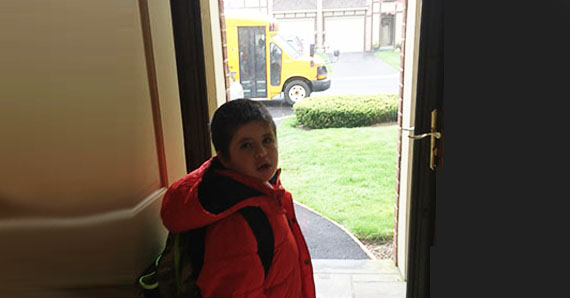
As a parent, it takes a lot of trust to send your non-verbal child into the world. Essentially, I’m shipping one of the most cherished parts of my entire life into a society that has treated me terribly on some occasions. Realizing that I have the capabilities to speak up and defend myself while Lucas, my 12-year-old son, does not only make it more concerning.
When it comes to school, I rely on the notes they send home, forming a unique channel of communication. There’s an undeniable honesty in these exchanges, honed over years of back-and-forth notebook updates. Phrases like “didn’t seem like himself” or “needed redirection” convey more than words can express. I experience a rollercoaster of emotions, from concern on “an okay day” to jubilation on “a great day.” What I want most is reassurance that my son is thriving when I’m not by his side.
These notes require trust because Lucas can’t verbally recount his day. While we have ways to communicate needs and wants, discussing past actions remains a challenge. Lucas can convey his current feelings, whether it’s tapping his elbow when hurt, gesturing toward the cabinet when hungry, or simply falling asleep when tired – even on roller coasters. Seriously.
To address the school day with him, especially once it ends, is nearly impossible. I will say, “Did you have fun in school?” But that is more for me than for him. It’s to just keep language going, but also in the hopes that he might one day “get it” when I ask that.
After all, you never know when he might understand something and not have the ability to communicate it. One day, he suddenly understood what “cup” meant. How long had that been going on though? I think back to the times when he never demonstrated that knowledge. Still, I still continued to ask him to get his cup for me. Things like that keep me, as the father to a child without verbal language, going. It’s not pretend. It’s not playacting. It’s pushing my boy to reach goals by assuming that he may have already reached them, but hasn’t yet expressed so. Many times, he has.
All of that being said, there’s one note from school that sends shivers down the spine of any special needs parent. It’s the bad notes. It’s the ones about meltdowns, tantrums, refusals to get up, difficulties transitioning, whining, flailing, grabbing, biting, and – the worst one – hitting.
Truth be told, Lucas isn’t a hitter. That doesn’t mean that it’s never happened. In times of extreme frustration, I’ve watched in horror as he took a half-speed swat at an aide during pick-up. It sinks a pit in my stomach and, as most in my position would agree, it can make you feel like the worst parent in the world.
That’s why, upon hearing that my son has lashed out, whether in a note or in person, brings up a visceral reaction. I am embarrassed for him and for me. My immediate thought is to apologize and have him do the “no, no, no” hand motion to show that he understands the gravity of his actions. One of my top priorities is to make sure that he knows lashing out is wrong.
As he grows into a giant man, it’s important for Lucas to understand that you don’t get your way by swinging at people. That, along with keeping his clothes on, is one of the most important lessons that he needs to know as an adult. People get upset when a special needs child hits them. People call the police when a special needs adult does. My job is to protect others from that and to protect him from others.
And that is what leads me to the second thought that crosses my mind upon hearing that my little guy has reacted to something with his hands. I ask the most important question.
What happened right before to cause him to do that?
This question may seem like an attempt to absolve him of responsibility, but it’s not. Hitting is inexcusable, and Lucas shouldn’t resort to it regardless of the reason. However, I know my little guy doesn’t initiate fights like a cage fighter. Something has to have triggered his actions – whether he felt threatened, misunderstood, or mistreated. It’s vital to understand that even though autism may guide his actions, his reasoning is grounded in reality.

And, to be frank, even if his personality was one that could hit at times, I’d still want to know why it happened. Being an advocate for your child doesn’t mean we let them get away with everything, but it also doesn’t mean we brush off overwhelming moments that they face alone. I’m here for him. Even when he does something “wrong”, I need to understand why. I need to be able to help guide him.
As his dad, my goal is to ensure the reasons behind these actions are understood and addressed. Whether he’s antsy, feeling unheard, or perceiving aggression, it’s my responsibility to guide him toward constructive responses. Our kids aren’t robots. Their emotions, both positive and negative, stem from their experiences. Our role is to minimize moments of jeopardy and prioritize understanding.
Above all, our parental duty is to protect our children. Lucas may not communicate everything verbally, but when he reacts in a way that contradicts his usual self, it reveals a lot. It’s up to me to ask the right questions and be the advocate he needs.
READ NEXT:
WHEN HUNGER STRIKES: AUTISM, AGITATION, AND UNDERSTANDING


 Hi Blog! I'm Dad.
You must be logged in to post a comment.