

The scariest part about having a child diagnosed with autism at a young age is the unknown. In a world of checklists, there is no checklist for what or who they can become.
In hindsight, that’s common sense. No one can tell you who your child will grow to become. Things that a two-year-old loves often change by five or ten. Life evolves and people grow. I realize now that my frustration with professionals who were unable to tell me “what autism will look like for my son” at a young age was misplaced and unfair. He grew into who he is now and no one could have predicted it.
That unknown factor played heavily into a lot of my future worries. All I knew about autism was what TV and movies told me. There’s repetition and schedules. Dustin Hoffman screamed when Tom Cruise hugged him. It was all very cold in my mind. Lucas, my only son, was going to grow further apart from me, locked behind silence…or whatever nonsense memes happened to scroll past me at the time.
Fast forward to today and that’s the furthest thing from the truth. My son is the most loving non-verbal little man you’ll ever meet. I am showered with hugs and kisses, usually out of nowhere. The smile I get from him and the love he shows all fly in the face of the assumptions I made years earlier.
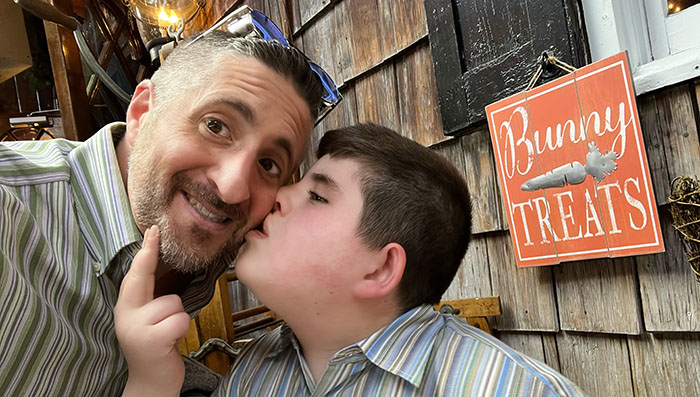
Lucas is nothing like I expected, despite being a “worst-case scenario”to many. Having never said a word and dealing with limited independence, life skill knowledge, and communication, my son’s challenges were the ones I feared the most back then. This is what I thought would be insurmountable as a parent.
Yet, alongside his sister, he’s now one of the two brightest stars in my life. I wouldn’t trade him for anything.
Is he easy to understand? Not in the traditional way. Lucas can’t tell me his dreams or comprehend the concept of autism. Deep concepts and even some basic ones are out of reach. Whether or not he “gets” the idea of a holiday is a mystery. In fact, whether or not he gets the fact that days are separated from each other by night and have different names is a mystery. Many things, on the surface, make him seem to be a boy operating on a different wavelength than anyone inside or outside our home.
All that being said, with the years gone by, I get him. Just like any parent, bonded to their kid, I understand what he wants, often without words, gestures, or even his communication device. I can sense when he’s happy or what actions will make him laugh. I know when he’s hungry, tired, or scared. I know when he needs to be included and when he needs his personal time. I totally get this kid.
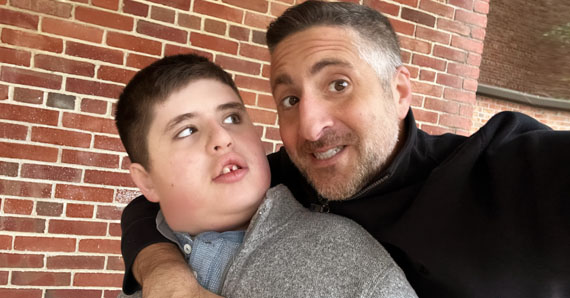
The reason why is that, while he may be on a different level, that level is one of truth and honesty. His needs and wants are usually on full display and never hidden behind something else.
What do I mean? Well, when it comes time to eat and I ask Lucas what he wants, he tells me in a few different ways. He might press the button on his AAC to make the robot-voice lady say, “Pizza.” He could take me by the hand and adorably lead me to the freezer where he double-taps the frozen pie waiting there. If he doesn’t care and just wants food, he’ll just tap his mouth.
That’s simple, right? Easy to understand. You’d get it and I get it. When Lucas is hungry, he lets you know.
Now, ask someone else who’s been bogged down with those cumbersome words and phrases. What do you get?
What do you want to eat?
I don’t know. What do you want?
I asked you.
Well, are you hungry?
I asked you first.
I don’t know. What are you in the mood for?
I’m not in the mood for anything. I asked you what you want.
I’m not eating if you don’t eat.
I thought you were hungry.
Yeah, I am. but I don’t know. I can wait.
Fine. Then we can wait.
Ugh. I’ll just order myself Chipotle.
What?!
Compare that scenario to the kid who taps the pizza. Who’s easier to understand?
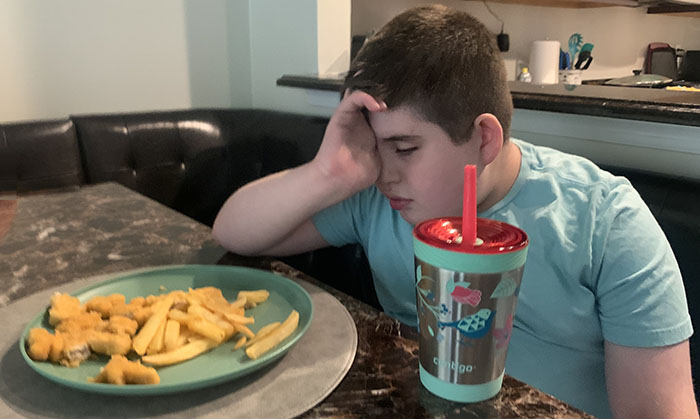
That’s the big difference between my special boy and the people in your neighborhood. Lucas doesn’t play word games or dance around subjects. He doesn’t toy with semantics when it comes to his desires. Sure, he might not have long-term goals and dreams like many of us do, but he knows what his short-term ones are. He knows what he wants to eat, do, or experience and there’s no reading into his meaning to get there. He’s never anything less than truthful.
That’s the honesty of a child like mine and the entire crux of autism appreciation for my family. Would life be easier for him with verbal language? In many ways, yes. Do I wish he had a more advanced skillset when it comes to living independently? Again, yes. Do I find that his lack of language stops him from expressing himself when it comes to what he wants? Absolutely not.
If anything, my boy is the most open and honest person I’ve ever met. The house could be burning down around us and he’d tap me on the shoulder for Pirate Booty. It might not be the most convenient time for something like that, but there’s something refreshing about a personality that sees the world that way.
In the end, the one thing I thought I knew about autism turned out to have the exact opposite effect. For a boy who doesn’t speak, Lucas is able to tell the world what he wants better than most of us can with a full dictionary in our arsenal. If that’s not something that deserves appreciation, I don’t know what does.
READ NEXT:
Mirroring Positivity: How My Son with Autism Reflects My Behavior
Now Posted: Check out my appearance on Jubilee’s YouTube Series “Middle Ground”



 Hi Blog! I'm Dad.
You must be logged in to post a comment.