
When it comes to meals, my non-verbal son, Lucas, thinks they’re all a group activity. If someone brings themselves a plate of food, he perks up, looks over, and casually approaches. Fixing his gaze squarely on your plate, he’ll slowly reach his hand out.
If you don’t stop him, he will attempt to take some for himself. If you do engage, he will slowly bring his hand to his chest as if to say, “Me?” Then, at the same speed, he will touch his lips as if to ask, “May I gobble it all down into my food hole?”
Let me walk you through some possible outcomes of this situation and admit, right up front, that they’ve all happened at one time or another. As my son has grown, so have I in terms of understanding how to teach him to live with other people. Yet, to learn those things, I’ve had to make my own missteps throughout our time.
In the earliest days, when Lucas was still tiny and expressing himself was few and far between, seeing him come over and ask for my food would have been met with happiness, applause, and an eagerness to hand it over. “Yeah? You’re hungry? Is everyone else seeing this? Look! Lucas is asking for my food. Here, buddy! Good asking!”
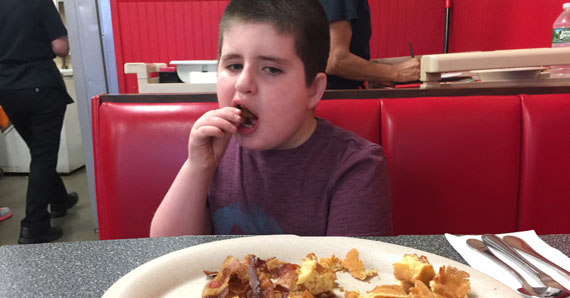
While a nice way of rewarding communication, this response probably didn’t do us any favors in terms of stopping him from assuming the food of others was actually his. It also helped mold him into the little hamburglar that was to follow.
During those proceeding munchie-nabbing days, the response was less about pride for his asking. It was more about peace and personal hunger. On those frustrating days, my boy was initially rebuked.
He’d come up with his hand outstretched and I’d firmly say, “No! This is my food. You just ate. No.” Of course, he kept pushing forward and was more insistent with each ask. It made eating next to impossible and, after denying him repeatedly, I’d give in, hand him my entire sandwich, and go make another one.
If he was neurotypical, he would know that I was unhappy with this exchange. I didn’t hide my annoyance. It was usually an angry look, a loud sigh, and a literal shove of my plate in his direction. For most kids, that would be enough to send the message that this behavior was unacceptable. For Lucas, it meant nothing. He’d devour his reward in one bite and then beg me for the second sandwich I made myself.

That was then. So what do I do now? Well, I can tell you because it happened again on Sunday. Lucas should have still been full from his waffle and pirate booty when I sat down on the couch with a freshly made sandwich for myself. As I did, his eyes lit up like a cartoon cat spotting a mouse. The slow walk over followed and his outstretched hand hovered over my plate. I quickly intercepted his paw, grasping his wrist with my hand. He looked at me and I told him, “No. This is my food. You just ate.”
Of course, this went along with my hand gestures and enunciated phrases. He knew what I was saying. The difference between now and those previous scenarios is that today is that I now have no doubt that he gets it. There’s a big difference between not understanding something and not liking it. He understands the situation. He just doesn’t like it.
I know this because he let out a low whine before tapping his chest and mouth. Again, I told him that it was my food. He hated that answer, began stomping around the room, and “crying” over not getting his way. Crying is in quotes because there are no tears. It’s just an anguished yell that he knows sometimes gets him his way. After recognizing that he wouldn’t get to take my food by becoming the loudest one in the room, he sat calmly next to me and gave one last lip tap.
At this point, I had to make a judgment call. I did something that some parents in my position might not do. However, it’s something that I think is fair and teaches him about keeping his composure.
Tell you what. I’ll give you a small piece, but that’s it. OK? You were patient, but this is Daddy’s food. OK?
I then tore off a corner and gave it to him. He inhaled it in a second and then went off to play on his iPad. I finished eating, my son was happy, and there was little to no frustration on either side.

If Lucas was a neurotypical boy and asked for my entire meal, I’d say no. I might, however, offer him a bite. We all do that for one another. It’s only fair and I’d do it for my daughter. Hell, I might even do it for you. People share. They only share, though, if the person isn’t throwing a fit over wanting what we have.
We reward patience and consideration. It’s the same way I might take a fry off his plate, but I wouldn’t steal his entire order. That’s how society works.
Most importantly, he’s calm enough to take in these lessons now. He knows that when he stopped “crying”, he got to take a bite. He also sees that he doesn’t get to take someone’s entire meal. Since he’s not flailing around in a fit of rage, he can process all of this.
With a boy like mine, lessons aren’t taught while he’s screaming and yelling. Denying him even the smallest morsel and sending him into a fit is only going to encourage him to make a stronger move to snatch it next time. It teaches him the wrong thing.
By handing it the way we do now, he learns that people will work with you if you handle yourself maturely. For a 13-year-old with special needs, interacting with society in a socially acceptable way is one of the most important lessons to learn.
Early on, I celebrated any form of communication, even if it meant giving up my food. As Lucas grew, I realized the need to set boundaries and teach him the importance of patience and respect for others’ belongings. It wasn’t easy, and there were many frustrating moments, but each experience was a learning opportunity for both of us.
As he continues to mature, so do my strategies. Each mealtime interaction is a step towards greater understanding and social integration. My goal is to prepare him for a world where he is not just accepted, but welcomed and appreciated for who he is. Our journey is far from over, but with each shared meal, we’re making progress.
I don’t want Lucas to be someone the community tolerates or feels the need to work around. I want him to be an accepted part of society. My job is to show him how and send him into a world that he knows revolves around the sun…not my son.
READ NEXT:
Preparing for Tomorrow: Adult Care Decisions for My Non-Verbal Son
Hear James discuss this post and more on Friday’s Hi Pod! I’m Dad Podcast!
NEW PODCAST EPISODES ARE POSTED EVERY FRIDAY ON HIPODIMDAD.COM!



 Hi Blog! I'm Dad.
You must be logged in to post a comment.