

Have you ever crossed a busy street with a cranky non-verbal elementary school kid? It’s a live-action video game that, if you haven’t had the pleasure, is a terrifying experience from start to finish. I know from firsthand experience.
It starts with a precarious grip on my son’s clammy palm. While most parents get to interlock fingers or firmly grasp their child’s hand, I’d find myself desperately clinging to the two fingers he didn’t manage to pull away. Every step is another inch of lost connection.
You can’t just let go and try to get a tighter hold because, especially at that young age, Lucas wasn’t guaranteed to stay put. Lose the hand, lose the kid. It’s awful.
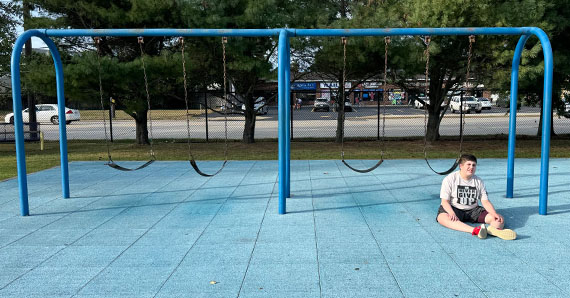
The hand is only half the battle. My son would walk in jagged patterns. With his two fingers as my only lifeline to guiding him, I watched as he flailed and spun under his own momentum.
Keep in mind, he’s also walking at a snail’s pace. He’s a tortoise in a world of hares and I tried – desperately – to keep him focused as we went.
Other factors come into play during this parental test, especially if I took the iPad he was playing with away when first began crossing. With it nestled under my arm, he trotted like an ostrich, craning his neck into strange positions for a fleeting glimpse of the Elmo video he’d already seen a thousand times.
It sounds daunting – and it was. But the worst was yet to come.
If Lucas was annoyed at losing his device for this ten-second walk, or if he became agitated or tired, he’d sit down…right in the street.
You could feel it when the mood hit him as suddenly his hand was pulling me closer to the ground. When he was very small, it always took me by surprise. I’d have to stop and physically lift him up.
As he grew and this routine became more familiar, I’d simply raise my arm in the air, keeping his arm to afloat too. He’d spin like a windchime until we reached the other side, where I’d give him a stern talking-to that he ignored.
While he doesn’t really do that anymore, I’m never sure if he might decide to go retro and try it again. Every time we cross the street, even though he’s great at it in his teen years, I am on high alert.
I share this story because, to someone unfamiliar with a non-verbal boy with autism like mine, there’s an easy conclusion to draw—one most people think without even realizing it.
You’d think Lucas has no sense of urgency.

I get it too. I’ve tried hurrying him to get dressed, use the restroom, or finish his food. It rarely works. He just stares at me, with a deadpan expression that’s hilarious in most situations. In pressing moments, though, it’s aggravating.
So there you go. My non-verbal son doesn’t understand pressing issues on a time crunch. That’s the problem in a nutshell. Getting him to move quickly just doesn’t register, right?
Nope. Not even close. When it comes to the things Lucas prioritizes, urgency is at the very top of his list.
Have you ever had Pirate Booty? Picture cheese puffs with far less cheese. That’s Pirate Booty. My son loves it. It’s his favorite snack.
When he wants some…he really wants some. The need hits out of nowhere, and suddenly – Poof – he’s in the kitchen like he’s starring in a Mr. Clean commercial. With a frantic sense of determination that people usually reserve for emergencies, he grabs my hand and drags me to the cabinet.
I could be on fire myself and he’d still do it. When he wants what he wants, he knows that we need to move fast. That’s when he suddenly “gets it”.
Even that story I told about crossing the street shows that Lucas knows what urgency is when it matters to him. His iPad is one of his most treasured possessions. If the WiFi cuts out or he accidentally lands on a YouTube screen that requires a password, he comes running over like a pizza delivery driver in turbo mode. I never see him move faster than when something goes wrong with his device.
His extreme need for the device was so apparent that a past teacher once turned it into a gym activity. They’d hold his iPad and run, making him chase them to get it back. While I wasn’t thrilled with this method and eventually asked them to stop, I could appreciate the logic. Lucas was so motivated by his device that it felt like the only way to get him moving.

Today, he’s improved in many ways. His persistence for Pirate Booty and devices hasn’t changed, but he now understands that my urgent requests matter too. Through repetition, receptive language, and maturity, Lucas has started to grasp that urgency isn’t reserved solely for his own needs.
I’m incredibly proud of him for that and of us for getting there together. Like so many of the skills Lucas has learned, it’s not something you’ll find on a checklist. It’s not like tying shoes or brushing teeth. It’s more abstract, something rooted in the trust we’ve built over time.
It comes down to one thing. Lucas trusts me, as his father, to know what’s important. He might not always think crossing the street promptly is a big deal, but he understands that I do. And out of respect for me, he does it.
I love him for that. It makes me feel good to know we’ve created this kind of relationship. It’s taken time and a lot of effort, but as Lucas grows, I keep reinforcing it. For things like this, time has been our friend, but patience and understanding have been our saviors.
READ NEXT:
It’s Not the Spilled Cheerios That Keep Me Up at Night
Hear James discuss this post and more on Friday’s Hi Pod! I’m Dad Podcast!
NEW PODCAST EPISODES ARE POSTED EVERY FRIDAY ON HIPODIMDAD.COM!


 Hi Blog! I'm Dad.
You must be logged in to post a comment.