
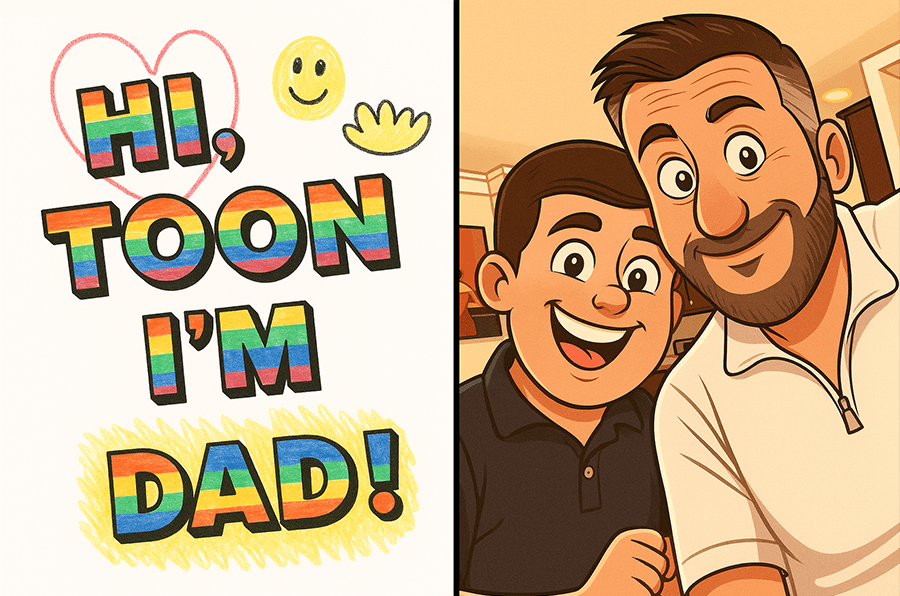
Our new series “Hi Toon! I’m Dad” is now live.
Scroll down to see the first episode and follow on TikTok/@HiJamesGuttman (and all social media) for more each Friday

LISTEN TO THE FREE PREVIEW BELOW ON SPOTIFY:
The first few years of my son’s life were confusing and – complete honesty – frightening. Leading up to the day we finally said “autism”, I felt like I was slowly falling off a cliff.
For new parents, “autism” is treated like a cursed word. In most cases, it’s never said out loud.
You’re told to keep an eye out for any problems or “red flags.” If your child isn’t hitting milestones on time, friends and family tell you, “Don’t worry,” because “everything will be fine.”
That’s what they said when my son wasn’t lifting his head during tummy time as an infant. Unlike his sister a few years earlier, Lucas seemed incapable of raising his face from the floor. I tried to give him the space to figure it out on his own and, while his struggle was adorable, it was also alarming.
There didn’t seem to be any strength in his neck or hands. Instead, he’d spin his little face around and eventually wind up with a mouth full of blanket. I’d swoop in, turn his head, and keep him from smothering… daily.
Eventually, though, he did learn to support his neck. Tummy time took longer, but it did improve. In that respect, it turned out “fine.”

Sitting, crawling, standing, and many other physical movements came with time. While they didn’t happen on the timeline the books said they should, they still happened. Sure, there were obstacles and my little guy struggled, but the worry was for naught. It turned out “fine,” just like all the well-meaning friends and family had assured me.
Then came language.
Lucas didn’t speak. He didn’t even try to speak. At most, he would let out a sound that resembled a word, but it was never on purpose. You couldn’t say, “Lucas, say hi,” and expect a response.
And I don’t mean that he wouldn’t say “hi.” I mean he wouldn’t say anything at all. For some reason, he’d clam up and stare at you. There was no attempt to imitate sounds, even if it was a sound he had made just moments earlier.
If that sounds confusing, imagine how I felt as his father. There was my kid, sitting in the backseat of the car, repeating the sound “Dah-dee, dah-dee, dah-dee…”
I’d get excited and call to him, “Lucas! You’re doing it! Dad-dy! Dad-dy! Say it again! Go! Dad-dy… Dad-dy…”
Sudden silence. I’d look back and ask him to repeat.
“You got it, buddy. Say — Dad-dy. Dad-dy.”
From there, he would tap his lips without making a sound. The more I asked, the more frustratedly he would tap his own mouth. Seeing the request was upsetting him, I’d feel bad and drop it.
“It’s OK, buddy. We’ll try again another time. I know you can do it.”
Five minutes later, he’d be doing it again.
Why can’t he do it when asked or prompted? Why is he able to make the sound but not understand to do it intentionally?
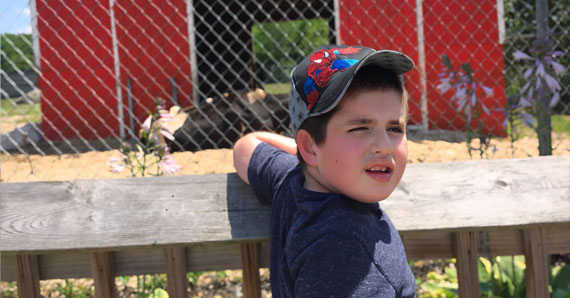
I don’t know. That’s a hard thing for a young parent to admit and one that I had to say many times when he was little. At an age where everyone else seemed to know everything about their preschoolers, I felt like I knew next to nothing about mine… and it killed me.
This wasn’t what I thought “non-verbal” meant when it came up in those early doctor’s appointments. I figured it just meant he couldn’t talk. I remember thinking that having a non-verbal son would be easier when he got older. Why?
Because then, I figured, I could simply ask him, “Yo. Why don’t you talk?”
I know it sounds silly, but I’m not kidding. Long before teenage Lucas ever entered my home, I imagined what that would look like. In my mind, he’d advance at a typical rate. Language, I thought, would be the only missing piece. And when he got older, it would all make sense. It would turn out “fine,” just like everyone said.
Those days were coming and I was waiting. When he crossed some magical age, I figured I could just ask, and he’d tell me. Maybe he’d type it out, or use a communication device to tap, “Ah yes, my vocal cords struggle, Father. But thank you for asking. I can explain it all now that we are in the future.”
Needless to say, that didn’t happen. Today, he uses his device to request things. He shows love and affection through physical hugs and kisses. We exchange information and emotions through intuition, gestures, and pictures. We have ways to communicate.
And while we are making progress every day to deepen our conversations and increase his ability to imitate sounds, we aren’t where I once envisioned we’d be.
But then again, today I know that vision wasn’t realistic.
To be honest, deep down, I knew then that it wasn’t too. There is one thing I believed back then that turned out to be true.
We turned out “fine.”
Does he talk? No. Can he tell me why? No. Still, we’re more than fine. We’re perfect.
There’s a reason for that, and if you’re a new parent wrapping your head around an autism diagnosis, it’s important to hear.
The life you picture down the line is not the life you’re going to have. No matter how bad you imagine or how good you imagine, you’re probably wrong. No one can predict the future of their family, not even with neurotypical children. That’s just not how life works.
Our present day is the culmination of all the days that came before. It’s not a flash-forward you can see or understand ahead of time. It’s part of a story that plays out slowly. The teenager you imagine your toddler becoming is a character of your imagination. The teenager they become is the result of the love, time, and bond you build together.
I loved my children from the moment they arrived. But the love I feel for them today is even stronger. We’ve built it together over the years. We’ve created the world we live in now.

The son I once believed needed to talk in order to be “fine” didn’t need to. He just needed to be part of our family. Anything he could or couldn’t do would simply be part of his personality. It’s part of a personality that we love.
There’s nothing my kids could ever do to make me stop loving them. And by the same token, there’s nothing they need to do in order to earn my love.
They just need to be who they are.
If you love your kids, everything will be “fine.” The rest, no matter how overwhelming it feels in the moment, is just incidental.
READ NEXT:
Raising an Autism Sibling Bond Built on Love, Not Obligation
Hi WORLD I’M DAD: How FaTHERS CAN JOURNEY FROM AUTISM AWARENESS TO ACCEPTANCE TO APPRECIATION
Audio – Digital – Paperback Available…Everywhere.
Get It On Amazon – Get It On Audible – Get It On Spotify – Get It On Barnes & Noble
 Hi Blog! I'm Dad.
You must be logged in to post a comment.