
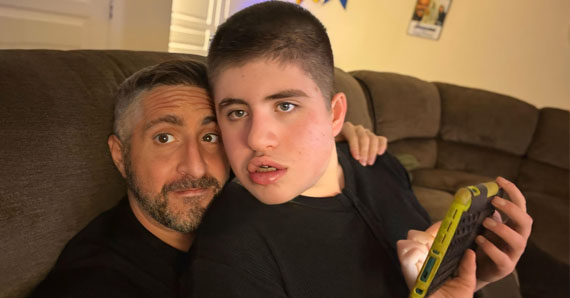
I share stories about raising my nonverbal son to show the world who he is. My goal, in each story, is to explain the reality and beauty of having a boy like him in our lives.
These posts are not a plea to help me “fix” him. For many without someone like Lucas, that would appear to be a pressing need.
It is not. Fixing my son is not a consideration because he does not need fixing.
That phrase, I know, sounds like a cliché you read on autism parent T-shirts. It sounds manufactured to drum up even more support for strength and independence. The world bites its bottom lip, wells up its collective tears, and sends a solemn salute to this parent so brave in the face of hardship.
But that too is wrong. When I say my son does not need fixing, it is not a catchphrase or a piece of quotable feel-goodery. It is a fact.
Fix implies that there is something broken. When it comes to Lucas, nothing is broken.
Some might point to his lack of speech as a problem that needs fixing. I can understand that point of view. For years, I had the same thoughts.
When Lucas was little, the missing words felt like his biggest obstacle to me. If only he could speak, we would all be fine. He would be fine. It would all be fixed.
It took a few years to realize that words do not equal communication. He could spout off the dictionary, but if he cannot tell me what he wants or needs, they are not as reliable for him as other forms of communication.
He still has no words and, in the end, that was not something that was fixable. Instead, it was something that we tried to teach him. When he could not imitate verbal language, we taught him to use communication tablets, hand gestures, and PEC boards. We did not fix the lack of words. We taught him a better system.

His lack of speech was not something broken. It was, and continues to be, a different way he knows how to share himself with others. Whether it is physical, mental, or simply a lack of understanding, spoken words are a far-off concept to him. So we did not force him to work in our system. We built a system that works for him.
That is not fixing.
Autism is a fundamental part of who my son is. His point of view is unique and, in many ways, awe-inspiring. Through Lucas, I learn that there are ways to see our surroundings that I never considered. The glare of a glass door, nearly invisible to those of us not looking for it, can capture his eye and send him over to examine it from every angle. My son sees beauty in things we never notice. I see beauty in how he notices them.
As a toddler, I thought Lucas’s worldview just needed guidance. I would watch him playing with a toy “wrong” and try to correct him.
He would be spinning the wheels on a rolling toy telephone and suddenly SuperDad would swoop in to show him how.
No, Lucas. Look. This is a phone. You pick it up. Hello? Hello?
He would watch me put the phone to my ear and pretend to have a conversation. Then, the second I was done, he would take it back and spin the wheels again.
After many attempts, I came to a conclusion. He does not need me to Dadsplain this to him.
He gets it. He sees me. I had already taught him to imitate other motions in the past. Whether clapping or waving, Lucas had no issue learning new movements and actions. We had already had successes in that area.
If Lucas was not imitating me with that toy phone, it was because that was not how he saw it. That was not how he wanted to play with it. He was not having a problem. He was not facing an issue. Nothing about it was broken.
The same can be said for his starting and stopping of YouTube videos. Take the tablet and try to get him to watch it as a simple program and he will patiently wait until you are done with your presentation before hitting that pause button again. There is no broken bridge to repair. This is not about a missing piece.
This is who he is. It is what makes him comfortable and what brings him enjoyment. My job was not to break that spirit. I do not think I could, and I would not want to if I was able to.
Are there areas of Lucas’s life that I want to help him do better? Of course. But teaching someone to tie their shoes is not fixing them. It is teaching them. I am a parent. That is what we do. If your kid picks something up at two years old, that is great. If your kid is still struggling at fifteen, you do not shrug your shoulders and say, “Tough, kid. I am retired.” You keep going. You keep teaching. You help until he gets it or until you physically cannot anymore. There is no time limit on helping your child learn.
The other thing to understand is that Lucas tries to tie his shoes. There are tasks that he works hard to comprehend. He wants to do them the right way. In those cases, you never give up on him.
Lucas’s way of seeing the world does not need fixing any more than someone’s neurotypical, football-obsessed kid needs fixing. We love them for who they are and work to make them the best version of themselves possible. After all, we are all parents. If you do not value who your child is deep down, then what are we even doing here?
If this story resonated with you, I talk more about what changed after my son realized I was really listening on this week’s episode of
Hi Pod! I’m Dad.
READ NEXT: It’s 4:30AM, and I Just Learned Something About Autism Appreciation
Looking for a speaker who talks about parenting, connection, and reframing expectations?
You can book James Guttman here.
 Hi Blog! I'm Dad.
You must be logged in to post a comment.