
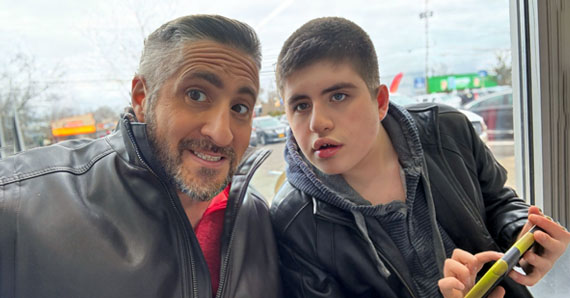
It’s easy for my son to be overlooked. When you’re a nonverbal 14-year-old with profound autism, most people assume you don’t understand much of what’s happening around you.
At the same time, I’ve also met people who believe the opposite. They see Lucas and insist that he understands everything. That he’s fully aware of the world around him and simply trapped inside his inability to communicate it.
The truth, as it usually is, sits somewhere in between.
Lucas doesn’t understand everything. Many parts of life remain far out of reach for him. But the things he does understand are often very different from what people expect.
At first glance, Lucas marches to the beat of his own drummer.
That drummer plays a tune that he loves, but most people can’t hear. He’s guided by his own desires and gravitates to the things he loves.
Those things can be confusing. They’re not the types of activities and enjoyments that you find advertised to the masses. There are no commercials for hopping around clapping. You don’t get many pop-ups for window glares or movies you can pause and unpause through YouTube. These are all very specific to my son.
Spend a bit more than a few minutes with him, though, and you start to see the complexity. Lucas may not understand the world the way we do, but he understands parts of it in ways that surprise people.
One of the clearest ways this shows itself is in how Lucas reads people.
Lucas can read energy. I don’t mean that in a crystal ball telepathic way. I mean that he has a good sense of people. He, like many children on the spectrum I’ve met, can sense the difference between calm serenity and brewing tension.
Get my son around someone who is jumpy, easily agitated, and constantly on the verge of a breakdown. If you do, you’ll see a kid who is, as he always is, sweet, but somewhat distant. He might request snacks from them or give them an obligatory head-on-the-shoulder goodbye. But he keeps his distance in ways that they might not notice, but I do.
Find someone who looks at him with kindness and gives peaceful interactions. You’ll find a much different approach. Lucas feeds on energy. He knows when someone is kind and pleasant. It’s in the air around him.
I know because I’ve seen it. Lucas has kissed people on the cheek after knowing them a few minutes. Some that he knew for years were lucky to get a polite obligatory nose-rub. It’s a big difference.
Lucas has always been a fan of calm energy. Even when I didn’t know if he knew what it meant, I showed him how to bring the temperature down. It’s been going on for years.
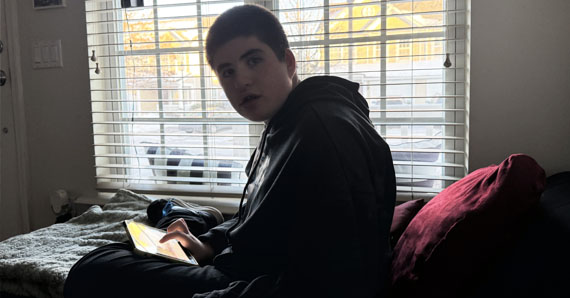
I remember the first time I noticed he was going a mile-a-minute. He had been engrossed in his iPad all morning. Starting and stopping Elmo takes a lot out of him. As he often does, Lucas accidentally pressed something that sent YouTube kids into some sort of Google Authenticator. He came sprinting towards me with it and placed it in my hand.
As I was fixing it, I could see his chest heaving in and out. His breath was heavy, and I, as a recovering heart patient, knew what I would do in that situation.
I stopped tapping his iPad and placed one hand on his chest. He stopped short and made eye contact with me.
Shhhh. Lucas. Breathe.
And with that, I took a deep breath.
I knew he would imitate the deep breath. He’s always struggled with copying mouth movements. But he did stop and breathe at a normal rate. Suddenly, he was back to base. The fact that I hadn’t fixed his iPad, yet he was still standing calmly, told me that he got what I was doing.
Since then, we’ve done it a million times. In those times, he’s always stopped short and brought his excitable energy back to normal. He understands what I’m doing, even if I’ve never been able to explain it.
That doesn’t mean he understands everything.
There are still many moments where Lucas is completely disconnected from the world around him. He doesn’t grasp long-term consequences. He doesn’t always recognize danger the way other teenagers do. Conversations are happening around him that he simply cannot follow, no matter how much we might wish he could.
And that’s the part that can be hard for people to accept.
Some want to believe that he secretly understands it all. Others assume he understands nothing at all. Living with Lucas means knowing that neither is true.
The truth is, I don’t need my son to be telepathic, a superhero, or some sort of alien life form just to accept that he’s nonverbal. Acceptance and appreciation for my son’s autism means that I don’t need to dress it up to make it something other than what it is. I see the beauty in reality, rather than fantasy.
People who tell me he “understands everything” have never even met him. They think this will fill me with happiness and joy, as if the truth is too hard to swallow. It’s not. He’s a teenage boy. Even if he was verbal, he wouldn’t understand “everything”. That’s just logical.
And that’s OK.
Like most people, my son isn’t all or nothing, which makes me love him so much. I see how unique he truly is and how knowing him comes with its own reward. I’m blessed to have a boy like him and know that together we can weather the low points, revel in the high points, and live happily in the middle.
If this story resonated with you, I talk more about what changed after my son realized I was really listening on this week’s episode of
Hi Pod! I’m Dad.
READ NEXT: Why Trust Matters More Than Understanding With My Nonverbal Son
Looking for a speaker who talks about parenting, connection, and reframing expectations?
You can book James Guttman here.
 Hi Blog! I'm Dad.
You must be logged in to post a comment.