
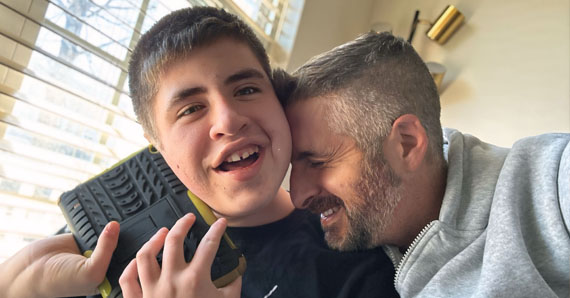
I first started writing about raising my nonverbal son in 2016. When I started, he was five years old.
Today, Lucas is 15, and to say we’ve come a long way is a drastic understatement. There have been so many changes.
The unexpected twist is that the biggest changes haven’t been in his behavior as much as mine. It’s been me, his father, who has seen a shift in understanding, acceptance, and appreciation.
I think about buying Lucas presents now versus then. Today, Lucas gets whatever makes Lucas happy. If he enjoys Magna-Tiles as a teenager, he gets them. LeapFrog light toys, bubble wands, or whatever else might be considered below his age range can be readily purchased if I think it might put a smile on his face. Suggested ages on boxes mean nothing to us.
Ten years ago, they did.
Buying toys for my then-five-year-old was nerve-wracking. Each purchase below his age range felt like I was pushing him further into a diagnosis I was terrified of accepting. It sounds ridiculous because it is ridiculous. Back then, though, it felt like a truth no one saw but me.
I’d walk through stores searching for anything he might like, and the only gifts that caught my eye had infants and toddlers on the box. I was in a constant state of inner turmoil and emotional tug-of-war. Should I get him what he wants, or will that be detrimental to his development?
The answer, eventually, was simple. Lucas should get what makes Lucas happy.
Neurotypical adults get to collect action figures and video games. My son with profound autism can play with See ‘n Say. There are no rules when it comes to joy. In the words of the famous ’90s philosopher Sheryl Crow, “If it makes you happy, it can’t be that bad.”
Some changes since then have come naturally with age. Running like a madman every time he found himself without a hand to hold is one I was glad to see fade. The sprinting days are behind us… for now.
I say “for now” because I know he could always pivot back. In the decade since I started writing these, I’ve learned that issues fade, but sometimes return. The trick is to celebrate the progress while understanding that nothing is ever fully gone.
The great food-stealing capers are a perfect example.
In his early years, my boy was the Hamburglar without the mask. If he saw food unattended, he found a way to get it into his mouth.
And he did it in the least graceful way possible. Pizza was stuffed into his face with sauce across his chin, cheeks, forehead, and hairline. Burgers were demolished with lettuce and tomato flying everywhere. These food raids were done in full Cookie Monster fashion.
Today, he doesn’t do that… with me.

I’ve heard stories from others, though. That instinct is still there. I know if I’m not paying attention, he’ll go after the vat of cream cheese on the table or whatever else he can get his hands on. I know because he does it with other people.
And that right there is the biggest change.
It’s the lesson I’ve learned over all this time and the reason for my autism appreciation.
Back in the early days, I looked at raising a child like Lucas as “thankless parenting.” I did everything out of love, expecting nothing in return.
And for a long time, that’s exactly what I got.
Young Lucas didn’t express appreciation or even acknowledgment at times. He showed no reaction when I walked into the room. Hugs and kisses were prompted and performative. Even as recently as five years ago, I couldn’t answer whether or not he missed me when I was away.
Our Wednesday reunions were often met with indifference. He’d walk up to me like, “Hey.” That’s it. I’d be overwhelmed with excitement, hugging him, and he’d be motioning for me to make him a quesadilla.
Still, I did it.
You don’t say hello just to get a hello back. You don’t do nice things just for the thank you. You don’t express love just to receive it. You do it because that’s who you are.
Today, I can tell you that Lucas absolutely misses me.
Does he make welcome-home signs and throw confetti in the air? No. But once he settles in and we’ve walked into my house, he wraps his arms around me with a kind of love I once thought might never come.
And maybe the biggest proof that those early days weren’t “thankless” is this:
Today, he’s on his best behavior with me.
He doesn’t melt down. He doesn’t steal food. I don’t have to drag him into bowling alleys. He goes with me willingly. Do you know why?
He trusts me.
Those early days of showing him love mattered. I anticipated his needs when he couldn’t express them, and now he knows I will always take care of him. It built a bridge of understanding over what could have been a lifetime of struggle.
Today, Lucas appreciates me just as much as I appreciate him.
It didn’t happen overnight. It wasn’t easy.
But it was worth it.
And I’m glad I never stopped.
Looking for a speaker who talks about parenting, connection, and reframing expectations?
You can book James Guttman here.
If this story resonated with you, I talk more about topics like these on
Hi Pod! I’m Dad.
READ NEXT: It’s 4:30AM, and I Just Learned Something About Autism Appreciation
 Hi Blog! I'm Dad.
You must be logged in to post a comment.