
Words can easily be misinterpreted. We hear what we want and understand what we hear. Most times, however, what one person says can have a completely different meaning to another person’s ears.
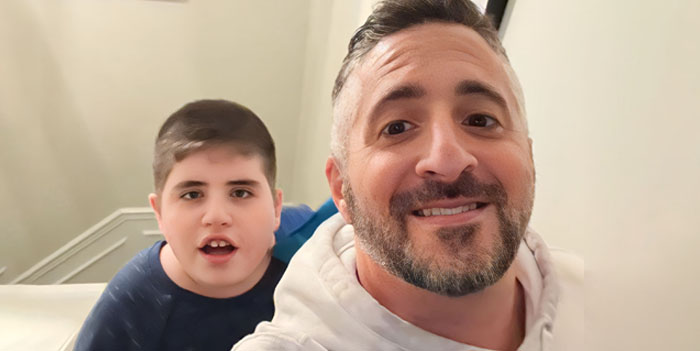
Being the father to a non-verbal boy with autism has taught me this in ways that many don’t realize. Looking back to his early days and reliving that feeling of dread that came from hearing the term “non-verbal” can seem like a lifetime ago. My initial reaction and impending sense of doom upon hearing it weighed heavily on me. The eventual reality didn’t come close to matching that fear of the unknown.
For me, at the time, it meant I would never get to “speak” to my son. Many might still assume that when they hear he doesn’t use verbal language. How can one talk to someone who doesn’t talk?
Well, there’s the obvious fact that talking, speaking, and verbalizing are very different than conversing. Lucas and I are able to get our points across to one another in a number of ways. Whether it’s a gesture, expression, or a push of the button on his communication device, he lets his feelings be known. Non-verbal doesn’t mean silent and alone. It means exactly what it says. It means he doesn’t speak words.
His communication, however, is more centered around needs and requests. Abstract ideas aren’t as easily shared as the more direct ones. So when I write about how he and I will never have deep heart-to-heart discussions about life, love, hopes, and dreams, it’s true. I have accepted that he and I won’t be able to share philosophies on why we’re here, who we are, and assorted other gems of wisdom.
However, not having a conversation doesn’t mean that there’s no talking. While he might have other ways to communicate to me – me? I don’t shut up.
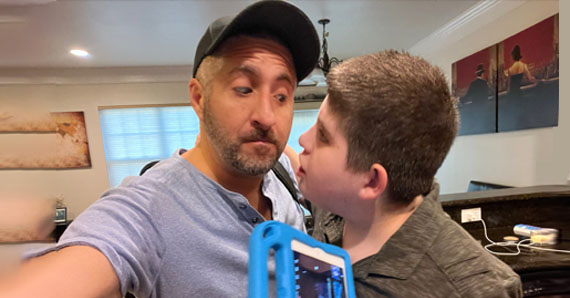
I can understand how those words can easily be misinterpreted. For me, as the father to a non-verbal child, deep discussions aren’t the same as interacting, conversing, and speaking to my son.
I speak to Lucas. In fact, I speak to Lucas more than I’ve ever spoken to anyone else on Earth. That’s a fact. He hears me talk constantly. Since the age of zero, he’s been my little sounding board. You name it, he’s heard it.
Identifying objects, food, and needs were always a big part of that. My son doesn’t eat a new food without me holding it out and telling him what it is. If his device is nearby, I will find the button and press it. The robotic voice with pronounce “pierogies” or whatever and I rest assured knowing that I did my part to help expand his understanding.
That, however, isn’t where it ends. Remember those deep conversations that he and I will never have? Well, we have half of them. We have half of them all the time.
The only difference is that my half is the only half speaking. He’s the one doing the listening. Well, actually, usually he’s not even listening. He’s present as my voice fills the room. We exchange laughs and smiles and, while he might not “get it”, he hears it.
I hope he doesn’t “get it” during these discussions, because I tell him everything. Knowing that he struggles with comprehension, especially when delving into deeper subjects, allows me to really speak openly around him. Whether complaining, explaining, or simply talking out loud. I just babble on and he’s cool with it.
Foul language is kind of out the window too. When he was just coming into his diagnosis, a friend cursed in front of and immediately apologized. I told him there was no need. What’s the worst that could happen? He’ll repeat it? That’s kind of the plan here. Say whatever. No need to overdo it, but if my kid goes on a profanity tirade, we’re having a party.
Having a non-verbal child is not the result of a parent not talking to them. The amount of words I have shared with my son since his birth has been astronomical. For many parents to non-verbal children, someone assuming we don’t talk to them enough if like assuming we don’t breathe enough. Most parents like me talk to their kid endlessly too.
While he doesn’t understand 90% of the things I’ve said, that remaining 10 has been most crucial. It’s this daddy babbling that has reinforced his receptive language. From “cup” to “bath” to “bring me”, he gets a lot of the words that he needs to survive. That has been a direct result of hearing them said rather than being lead from place to place.
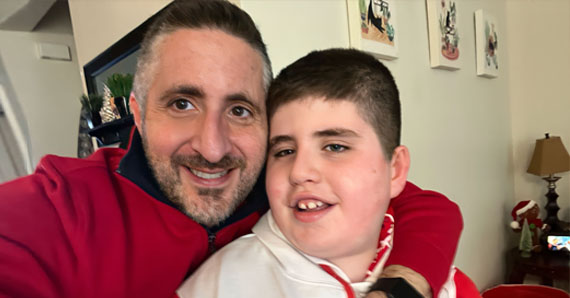
As for the things he doesn’t get, they’re just as important. He might not know exactly what I’m saying, but he knows I’m saying it to him. He knows that my tone is loving and my eye contact is sincere. He senses that he’s important and that these words he sees people share with one another are words his father shares with him.
He’s part of the conversation, even if he has nothing to add. He’s part of our lives, even if he has nothing to say. He’s part of our family because we love him and we’re part of his life because he loves us. There’s no way to misinterpret that.
READ NEXT:
The Most Important Thing I Had To Teach My Non-Verbal Son

 Hi Blog! I'm Dad.
You must be logged in to post a comment.