
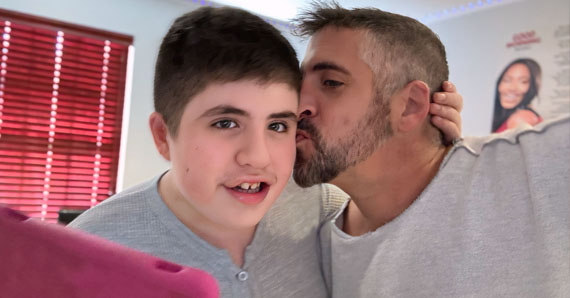
I get how people can misconstrue the phrase “non-verbal”. When they hear that my son lacks verbal language and has comprehension issues, they lose sight of the meaning.
First, “non-verbal” doesn’t mean silent. Lucas isn’t silent. In fact, Lucas is incredibly loud. When he’s happy or excited, he can’t stop himself from jumping and screaming with joy.
Even when he’s just even-tempered and on his iPad, you’ll hear grunts and groans as he swipes away. In fact, these sounds have taught us to rethink what it truly means to be “non-verbal,” challenging assumptions about silence and connection.
It has led to a level of autism acceptance in our home that few know about. My daughter and I, through the years, have learned to accept blood-curdling screams as background noise during times when they should cause panic.
When? How about 4:30 in the morning? My boy, a hybrid night owl and morning bird, gets up and begins running his hands along the gate of his room like a prisoner in a 1920 moving picture. His metal-clanging alarm sends me coming right away. It naturally pulls me from sleep the moment I hear the rattling.
I dash to his gate and, usually try to coax him back into bed. This is the most selfless thing I do because, although he will appease by climbing back into this sheets, he’s up again in 15 minutes to clang again. It’s not enough time to return to sleep and just turns my morning into quarter-hour torture.

From his room, Lucas screams at the top of his lungs as if Michael Myers is outside. There would have been a time when this type of sound would send me running for the police. Now, it’s just early morning Sunday. I just need to make sure the windows aren’t open. I get enough weird glances when I go to the mailbox.
Another misconception has people believing one of two things about who my boy is. On one hand, the person might think that Lucas understands every single thing and simply can’t speak. They imagine that we handed him a communication device and he immediately swiped, “Hello. I am so grateful that you’ve unlocked this tool for me to engage with you all. How about this economy? Am I right?”
No. It was “Pizza.” Over time, it became “I. Want. Pizza.”
My son isn’t a boy who grew, learned, and was taught things before losing language. He is a boy with autism who struggled with developmental milestones and communication was one of them. The things he knows are things we’ve taught him. It’s a slow process but his progress has been amazing.
The other side of that fence is full of people who think the opposite. They believe that Lucas understands nothing. They don’t say hello to him when he’s standing around. They don’t include him in plans or invites. They don’t see him as a person. Those are the ones I have the biggest issue with.

Let’s forget the ignorance that comes from writing off a person immediately without taking the time to know them. Put aside how rude it is to purposely not say “hello” to a person because you might not get one back. Ignore all that.
The biggest issue is that they’re so focused on what they see in front of their faces, that they don’t appreciate the depth of my non-verbal son. Lucas’s lack of communication doesn’t shut him away from me, as his father. In many ways, he and I have a stronger sense of understanding than most people have with their kids.
Trust me on this. I have a neurotypical daughter and ordering from Uber Eats can be like planning a rocket launch.
She isn’t hungry but wants food. She wants me to pick the place. I name four things, she said “no” to all of them. She changes her mind about restaurants and styles. In the end, we end up ordering from the first place I suggested and, even as she’s eating it, she’s iffy about whether she even wanted it in the first place. End scene.
Want to know how I figure out what to feed Lucas? Ready?

I look at him, from as far as across the room. Sometimes I will say his name to get his attention, but typically he can sense that I’m staring over and he’ll pick his head up.
Next, I put my hand to my mouth to say, “Eat.” If he is hungry, he will touch his mouth.
Again, with no device around for him to swipe an order into, I will ask “pizza” or “chicken” or “quesadilla”. If he wants the item I mentioned, he will touch his mouth to say “yes”. If not, he will wave his finger to say “no.”
Then I make it. Then he eats it and loves it. Then we’re done.
Did we get to this point overnight? No. It took a while. How long? Long enough, but not nearly as long as one might think. He had the motivation to figure out this particular process. Actually teaching him to stop stealing people’s food took about ten times longer than teaching him how to ask for his own.
In a world quick to define people by their differences, Lucas has taught me that communication is far deeper than words. He has shown me that life is full of subtleties that most people overlook. The loud moments and the quiet gestures are the things that form a bond beyond words. You haven’t truly listened until you’ve learned to hear without words.
READ NEXT:
Divorced Dad On “Staying Together For The Kids”
Hear James discuss this post and more on Friday’s Hi Pod! I’m Dad Podcast!
NEW PODCAST EPISODES ARE POSTED EVERY FRIDAY ON HIPODIMDAD.COM!

 Hi Blog! I'm Dad.
You must be logged in to post a comment.