

I openly acknowledge that caring for a non-verbal child with autism can lead to moments of uncertainty. Sometimes, when my child experiences a sudden meltdown or tantrum, I find it overwhelming and struggle to pinpoint the cause. It’s important to me to be honest about this, even though it can be challenging to admit as a parent. This is simply the reality we face.
However, just because I don’t know why he’s upset, that doesn’t mean that there’s no reason for it.
It’s one of the most common misconceptions that people, parents included, sometimes have about a child like mine. Lucas is a 12-year-old boy with autism and some of his behaviors can be confusing. It’s not limited to meltdowns either.

Often, he will jump around and clap with excitement or interact with his iPad in ways that feel random. If you don’t know why he’s reacting a certain way, it’s easy to write off as being done for no reason.
It’s never for no reason.
I realized that the first time I sat down and really paid attention to his screen time. Lucas had long been obsessed with one particular Sesame Street YouTube video. He would start and stop it for, what felt like, no reason at all. I had long just written it off as “autism” and gave it no further thought.
The day I sat down next to him, I realized the cause. In this particular part of the video, there was a swipe effect that blended one scene to the next. It washed over the screen and made a “swoosh” sound. Lucas, demonstrating pretty remarkable insight, had figured out that if he paused the video and pressed play right after, it would rewind one second. When he did, it would replay the “swoosh” swipe effect. I was pretty blown away.
Whether or not you agree with his feelings about how cool that effect is doesn’t matter. What matters is that he wasn’t doing it for no reason. Nothing he does is for no reason.
Meltdowns get all the attention in narratives like this and that’s because they present an urgent need for understanding. No parent wants their child to be upset, especially for a reason they can’t understand.
Lucas has meltdowns on occasion and, as I wrote a while back, they have grown less and less frequent with me in recent years. The main reason why? I stopped thinking that they happen without cause. I stopped writing them off as simply “autism”.
Don’t get me wrong. Sometimes it is autism, but only in the sense that his reasons are associated with autism-inspired personality traits. In many cases, it’s a feeling of being overwhelmed. Maybe he’s tired. Maybe he’s hungry. Maybe he’s frustrated. Either way, there’s always a reason.
Recently, during one of his sister’s outside school activities, he began hopping around with an annoyed cry. The heat was beating down on all of us and it was easy to simply say, “Oh. He’s hot and tired. This is just another example of an unknown issue causing him stress.”
I walked over and offered a “hush” as I rubbed his shoulders. His teeth clenched and his eyes squinted tightly. In one of his classic meltdown motions, he pushed his lips against my cheek for an aggressive kiss. He does that when he’s upset and, even though it seems more headbutty than kissy, it’s adorable in a sweaty, angry way.
What’s wrong, buddy? Is your iPad too dim?
I looked down and saw that his screen was hard to see with the glare of the unseasonable warm September sun above. I attempted to swipe from the top right corner to the center and fix the brightness. That’s when I saw that it wasn’t registering my swipes. It wasn’t reacting at all.
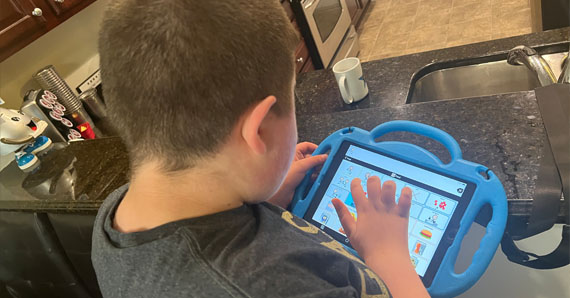
This particular device was on its last legs. He was upset because his obsessive start-stop game was impossible in its current state. One good whack to the back brought it back to interactive life and, as he snatched it from my hand, he was thrilled to hop away.
Do you know how easily it would have been to write that moment off? I could have assumed that he was just being “fussy” and left him all alone in his world, misunderstood and disregarded. It wouldn’t even have been done out of malice or neglect. It could have been something I just didn’t or couldn’t figure out.
Times like that send my brain into a rewind, trying to piece together past events where that might have happened. Rather than congratulate myself for getting things right this time, I beat myself up for the moments I might have gotten it wrong in the past.
Before you tell me not to be so hard on myself and how we all make mistakes, know that I realize that. I understand that my thinking may err too far in the self-deprecating direction. However, that’s what I need to do as a father. If I’m going to make his life the best it can be, I need to minimize crossed-signal incidents like that and try to never let them happen. I never want my boy to feel alone in the world, even once.
Everything has a reason. It’s on me to always try to figure out what that reason is. I might not always understand it, but I can try. As long as he sees that, he’ll know he’s never alone.
READ NEXT:
5 MISCONCEPTIONS ABOUT MY SON’S AUTISM


 Hi Blog! I'm Dad.
You must be logged in to post a comment.