
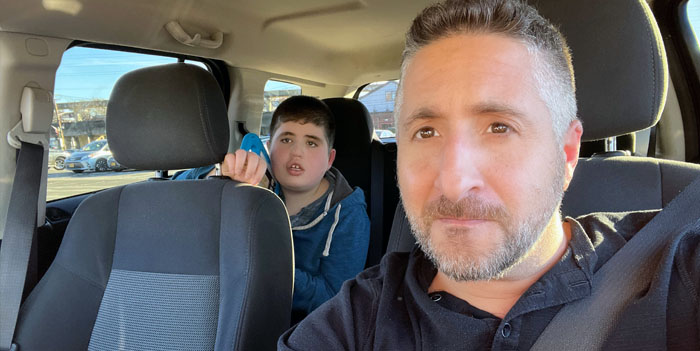
Most people find the fact that I raise a non-verbal child to be an interesting subject. Parenthood, as the father of a boy with autism, can be unique. I devote a lot of my writing to telling people Lucas’s story.
My daughter, however, is the one who first made me a father. Three years prior to her brother’s arrival, my baby girl showed up and changed my life. To this day, it takes nothing to knock me back into 2010, when she was running around the house with bouncy curls and making everyone say, “aw.”
Today, she’s 15 and, out of respect for her privacy, I try to keep the posts focused more on her brother. I get what it was like to be her age. I remember it vividly. It’s like brand management mixed with puberty mixed with – I don’t know – TikTok and trigger warnings? Life is confusing nowadays.
She and I have had so many conversations in her lifetime. The deep positive ones that center on life strategies stay with me the longest. When Lucas was first coming into his diagnosis, I thought about those discussions and lamented over these eventual missing moments with him.
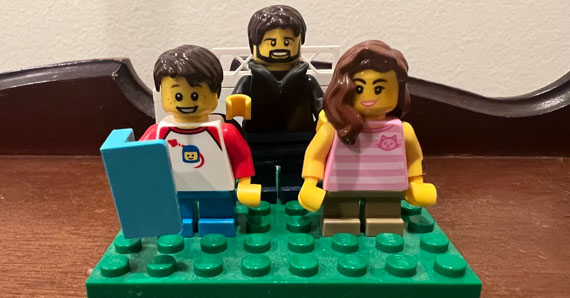
There would be no talks about baseball tryouts or cute girls in his class. Lucas won’t thank me for picking him up or ask my advice in a dispute with another kid. That’s just not who he is. When you’re told that your child is non-verbal and could possibly never speak, these are some of the first things you think about.
While those are just a handful of topics I get to discuss with my daughter, others, however, are becoming a little more common as she gets older. Anyone with a 15-year-old can understand what I’m saying.
When you have a kid, it’s important to remember you have to be the dad. It’s especially important as they hit adolescence. When I watch my little princess start to slip from the way I’ve raised her, I need to step in and have a tough conversation. I need to be “the bad guy.”
Nothing major, but we all need to be brought back down to Earth during our free-flying years. That’s what I had to do this past week during one of our many drop-off car rides. As is the case for any parent in my position, it was tough to lay down the law, but I did it because that’s what parents do.
Times like this show me how much time has passed since the bouncy-haired “aw” girl ruled my home. In my head, it was yesterday. In reality, it wasn’t. Talks like these force me to put my foot down, but also acknowledge that we’re both changing and, with that, so will our relationship.
After this talk, my daughter got out of the car and I waited until she was out of sight before I hung my heavy head. I flashed back to the personalized artwork she made me in kindergarten and days we spent watching TV in the toy-cluttered living room. My brain beats me up with pictures of earlier versions of us during less complicated times. I worry about doing the right thing and I think about how things will be as she gets even older.
Then, while I’m doing all of this, I feel a tap on my arm from the backseat. It’s Lucas, iPad to his ear and giant smile on his face, laughing and bouncing as I turn my head towards him. It’s his way of saying, “Hey. Why so glum, chum?” He doesn’t get it. He doesn’t understand this kind of painful talk.
And that’s the missing piece that so many of us never consider.

Sure, Lucas and I will never get to talk about varsity sports or saying no to drugs. His “severe autism”, in the words of many, will have “severe” consequences. How sad for the dad, they all cry out, who will never get to have wonderful “typical” talks with his son.
Yeah, but I also never have to have the terrible conversations either. Didn’t consider that one, huh?
The talk I just put his sister through would never be one that he and I would have. Lucas may be 12, but he’s not going through many of the same things that his sibling did at that age. He might get moody and he’s obviously growing physically, but there are many typical growing pains that he just won’t be experiencing. While the challenges he and I face are tough and somewhat abundant, lecturing him to “drop the attitude” isn’t one of them. Even if he did cop an attitude, a deep discussion won’t be how we solve it.
On top of it, there’s no sad bouncy-haired flashback with Lucas. Sure, I might remember when he was smaller, but his overall demeanor hasn’t really changed and our relationship has never really been altered. He used to be my biggest unknown, but now he is my constant. Many of the same interactions and activities we had when he was younger are still happening today. If I randomly remember a song he liked in 2015 and sing it, nine times out of ten, his eyes will grow wide and he’ll listen. He’s still the same little guy.
This is the part where I usually say that this isn’t simply a “silver lining.” But I won’t, because it totally is. This is very much a silver lining to an obviously dark cloud. Not being able to talk to your kid about life, hopes, and dreams is a big downer.
But not having to talk to him about hate, evil, and heartbreak while worrying he might “slip away” is also a pretty big plus.
One might not completely cancel the other out, but it’s still a pretty solid benefit that few people ever stop to consider. There may be many wonderful discussions that he and I won’t have. That’s what everyone thinks of first, but then stop there.
It’s not until you sit back and realize that it doesn’t end there. Raising a non-verbal child with autism is unique. It’s not unique in a way that makes it better than raising a kid without autism. But it’s also not unique in a way that makes it a catastrophe compared to raising a kid without autism. It’s neither. It’s just different.
Parenting, no matter to who, is about finding a balance between the positives and the negatives. The trick is to make sure you’re not so busy crying over the negative ones that you miss the positive ones as they come. I don’t do that with either of my kids. I’m the luckiest person on Earth to have them both as children and I will never take that for granted.
READ NEXT:
Waves of Acceptance: The Power of Acknowledging Autism and Special Needs


 Hi Blog! I'm Dad.
You must be logged in to post a comment.