
You’re never given a date when you need to accept that your child might be nonverbal.
In fact, it’s the opposite. There is no end date. You’re filled with hope from day one, and then everyone sort of leaves you there.
Doctors, teachers, and other professionals assure you that “anything can happen.” You just have to hold on and believe like the ’69 Mets. Those words are right around the corner, Tom Seaver.
So you wait. You hold on to hope when there’s nothing else to hold onto. You hold on to hope when that’s all you have left.
Everyone has a neighbor with a brother who went to school with a lady whose kid spoke when they were…how old is your son? Seven? Eight. They were eight. Just wait. It’s fine.
And you hold on for years. No one ever tells you to let it go.
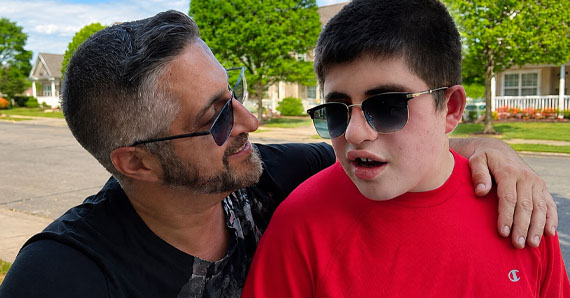
Don’t get me wrong, you should never fully let it go. Even today, as Lucas is 15 and yet to speak a word, I have hope that one day we can squeeze a “hi” out of his cute little head. That’s the kind of hope we have.
It isn’t, however, the type of hope that I obsess over. It’s something I want for Lucas. It’s not something I need for him anymore.
Letting that obsessive need go was the best thing that ever happened for our relationship. It was the day that I was able to see him for who he is, rather than what he doesn’t do. It was the day I was able to step back, look at him in full, and say, “This is my son.”
If we’re being honest, though, while the long-term effects of acceptance have been nothing but positive, initially letting go was one of the hardest things to do.
I felt like a bad father. How could I focus on other things besides language? This was a major issue. Lucas had to speak and, even though we spent countless years drilling the concept home with almost no traction, maybe it was something I was doing wrong.
Maybe the answer was to keep pushing. Refuse the communication device from school. Stand against picture-based charts. Insist that my boy could do this thing that, if we’re being honest, he seemed incapable of doing.
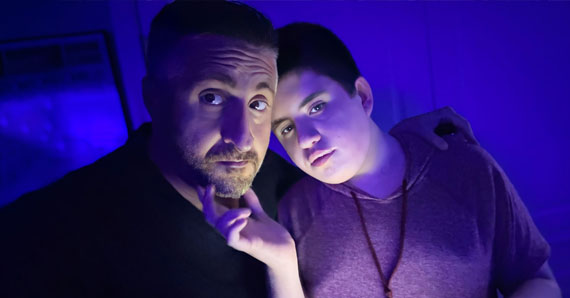
Even writing this, I can envision the miserable life that would have followed if I had had that point of view. My son would have been under a spotlight forever. We’d be judging him on this checklist that he struggled with since birth.
By letting go of that need for spoken language, at least in the obsessive way we had been approaching it, I was able to focus on making him well-rounded. I found the time to work on other skills he was missing.
Had I not done that, Lucas wouldn’t have the communication methods he uses today or many of the life skills we’ve worked on since then. Then where would we be?
We’d be stuck in a world where I was constantly forcing him to live up to something beyond his control without ever accepting him for who he is. We’d be in a world where I denied him the right to communicate through a device because I was too afraid to admit he needed it.
To me, that would be the biggest disservice I could ever do for him.
At the end of the day, this obsessive need for words wasn’t Lucas’s issue. It was mine.
Had I shut out any other assistance other than spoken language, my son would have no way of getting his point across. He couldn’t ask for food, say he was tired, or ask to go out. He’d be more locked away than anything I ever feared and, in that case, it would have been my fault.
That lack of being understood would have led to some of the worst behaviors you could imagine. To this day, the only times Lucas acts out are when he feels someone can’t understand him. If he doesn’t trust you to feed him, he melts down when it’s time to eat. That just makes sense.
He doesn’t do that with me because we’ve developed a system based on electronics, gestures, and trust. If my boy is hungry, he has ten ways to tell me, and he uses all ten in the span of 15 seconds. He gets fed. That’s why I have to buy him new pants every few months.
The only thing standing in the way of this wonderful life we have today was my fear. It was up to me, as his father, to admit that maybe speaking actual words could be out of his control. By allowing him to be the person he was meant to be, I wasn’t admitting defeat. I wasn’t giving up on him.
I was finally listening to him.
Sounds simple when you say it like that years later. At the time, I felt as though I was giving up.
But I also knew it was the best thing for Lucas.
So I did. I let go of that imagined future to give him the life he deserved. I’m proud of myself for putting him first, and I’m proud of Lucas for being himself.
This is who we are. It’s who we’re meant to be.
My son might never say a word, and that’s fine by me. This is Lucas, and he’s perfect.
Looking for a speaker who talks about parenting, connection, and reframing expectations?
You can book James Guttman here.
If this story resonated with you, I talk more about topics like these on
Hi Pod! I’m Dad.
READ NEXT: It’s 4:30AM, and I Just Learned Something About Autism Appreciation


You must be logged in to post a comment.