
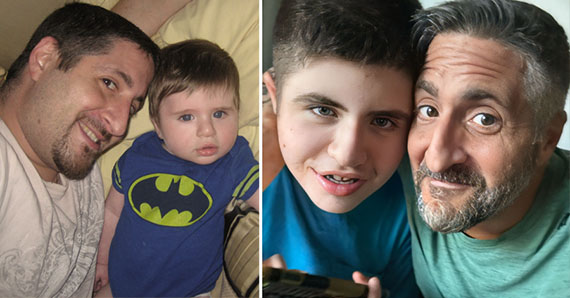
As my nonverbal son has grown and gone through changes, so too has this blog.
Early on, I wrote extensively about waiting for Lucas to speak. That time period was, easily, the hardest of my life. It taught me patience in ways that many people can never comprehend.
There’s no day that you’re told is D-Day for speech. I didn’t have a target month or moment to wash my hands, sit back, and stop worrying. In fact, it was the exact opposite. Every day was a visceral sense of panic.
Professionals and teachers would ask me what they should work on and all I ever could say was “speech.” In a statement that I’ve said more than once, my house is on fire and you want me to wash the dishes? No. Put the fire out. Get him talking.
That never happened in the traditional sense. Today, my boy can communicate, albeit in a limited way. Some bridges I can’t believe we’ve built. Others, I can’t believe we’re still working on.
Either way, though, that feeling of urgency lasted for a long time. Family, friends, and family friends all asked pointed questions that caused far more panic than they realized.
Finally, I had to put a limit on it for myself. One day I decided that while learning language will always be a goal, it was no longer the main priority. The priority was communication in general.
With that came the ability to focus on other goals too. Speech had become such an immense target that everything around it was invisible. Now, with the spotlight softened, I could see what else needed to be done.
For a long time, that’s how things were. That overwhelming feeling that I need to do more died down.
Don’t get me wrong. With a nonverbal child, especially with profound autism, that feeling that I need to up my game never went away. It simply let up a bit in his early teen years.
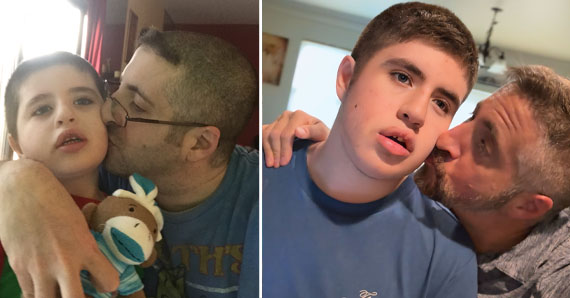
Now, he’s 15. Now language isn’t the overwhelming concern.
Now it’s about what we’re going to do when I’m gone.
Try that one on for size. We all know that parents like me deal with this worry, but few can understand how it feels to be in my rapidly-expiring shoes. Those same outsiders come with questions about our future.
And all their future scenarios have me written out of the story.
Do you understand how weird that is? The idea that, even in death, I still have this overwhelming responsibility, except I won’t be here to carry it?
This blog isn’t about how I am going to set all that up. Perhaps that’s a post for another day.
No. This one is about learning how to take a breath when all the air has left the room.
I’ve noticed it again in recent years. Sitting in silence at a red light and suddenly I’m picturing Lucas at 50 years old. What will he look like? Who will he be? How will he manage?
Just like the constant concern over when he will develop verbal language, concern over his long-term life can’t be the only focus either, and I’ll tell you how I know.
When pulling verbal words from my boy’s mouth stopped being all I cared about, I was able to focus on other aspects of communication. We developed gestures, receptive language, and communication techniques that, ultimately, made communication even easier without words.
And now, by focusing on things like life skills, understanding, patience, and behavior, I am ensuring that wherever Lucas ends up, he will do the most for himself that he’s capable of. I’m working to make him the most beloved person in every room he’s ever in…even if I can’t be in that room anymore.
It breaks my heart to think or write, but it’s the truth. Sad? Very. Imminent? Hopefully not. I want my son to outlive me by decades.
Still, picturing it brings a tear to my eye and the overwhelming sense of concern is still there, just as it was in those early years. Yet, I’ve learned how to handle it. I’ve discovered that caring for my son isn’t a one-issue task. It takes so much to build the life that he needs to grow into.
I wish I could be there forever. We all do. But, if Lucas taught me one thing, it’s that the future always becomes the present. What you build takes time and learning is cumulative.
Will I be gone when my son is 50? It’s possible. 60? Probable.
But will he be the best version of adult Lucas that he can be, as a result of all the work we’re doing now? Definitely.
Looking for a speaker who talks about parenting, connection, and reframing expectations?
You can book James Guttman here.
If this story resonated with you, I talk more about topics like these on
Hi Pod! I’m Dad.
READ NEXT: I’m Sorry My Son Drank Your Coffee
Follow Us on Facebook, TikTok, and Instagram.


You must be logged in to post a comment.