
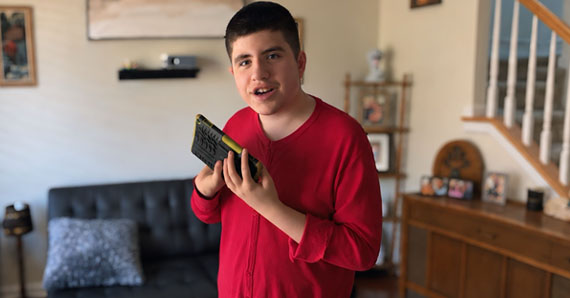
I always talk about how my kids, no matter how old they are, still feel like my babies.
It’s as if I was hexed at the times they were born and, from that moment on, they are always tiny to me.
My daughter is a literal adult. She’s away at college, living the life. Still, I imagine her with bouncy curls and oversized headbands. She’s always my baby.
Her brother, Lucas, is the same way. I call him “my little fella,” and my brain still tells me that I can lift him up in a pinch.
In reality, I’m Lucas’s little fella. I could probably pick him up during one of those adrenaline-rush moments where mothers lift giant cars to save their kid’s life. Regular pick-ups, that’s probably off the table.
My boy is bigger than me now. He has facial hair and furry legs. To me, he’s still a baby. To the rest of the world, he can look like a grown man.
Well, that’s not entirely true.
I’m pretty sure Lucas doesn’t see himself that way either.
Nonverbal with profound autism at 15, he still does the same stims and movements that he did at 5. Jumping, clapping, screaming, and manic hugging are all still on the agenda.
The difference now is that the screams are more alarming. They come from an adult voice. Happy squeals from a child, while not entirely common, are much more common than from a boy past puberty. I’m alone in all this, and sometimes, at night, they can jolt me from my sleep.
His jumping may be the same in many ways. He hops with excitement, just like he did in elementary school. Only now, his massive frame will rattle the house, sending items careening to the ground from shelves in his sister’s temporarily empty room. He snaps the slats on his box spring without a second thought. He does it all with a smile on his face.
Suddenly, his happiest moments have become his most destructive.
And, cards on the table, it scares the crap out of me. Not for me. I’m not scared of him. I’m scared for him.
I say this because my son will still come running to me with roughhouse hugs and giggles. He outweighs me and is maybe an inch or two shorter, yet we wrestle to the ground as he laughs. I’ll double-leg tackle him and then tickle him on the ground. He loves it. I do too.
But I know that I am one of billions of people on Earth. I know that someone else, in my position, would not see it the same way.
It’s our parenting paradox. We can see our children as babies, but have to remember, especially in a case like this, that the rest of the world doesn’t.
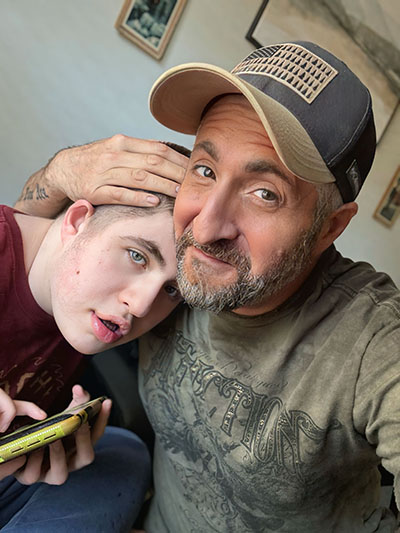
To someone else, seeing a nearly six-foot boy with billy goat gruff stubble come hopping at you with hysterical laughter doesn’t evoke a sense of “aww.” It evokes fear. It creates concern.
Those who live a life without someone like Lucas feel they have all the answers. They will read a story like this and say, “Well, you just need to teach him not to do that.”
Uh. OK.
That’s like saying that if a place doesn’t have a wheelchair ramp, you should just teach your paraplegic child to fly.
Lucas has always done these things. It’s part of who he is. Jumping, shouting, and coming in for hugs are all part of his life. I can’t stop him from doing them any more than I can stop myself from breathing.
I won’t stifle him or medicate him to the point of lying in a heap on the floor. I want Lucas to live his life in a way that makes him happy. As a parent, I’m aware of all he could have if he was neurotypical. I will be damned if I take away the few things he has in his life when he’s not.
For us, the key is to bring the mood down a bit. Jump. Scream. Hug. Do it all. Just tone down the volume a bit, kid.
Years ago, I started making my son “take a breath” in times of overwhelming excitement. He doesn’t actually breathe on command, but he does take a break. I will stop him, put my hand on his chest, and tell him to breathe. He will use that moment to regain his composure. He gets it because we’ve been doing it so long.
We’ve gone back to storybooks on a regular basis and quiet time where I will literally lie with and hold him, talking calmly about being aware of his surroundings. I do everything I can to make him understand that, as he grows in size, he has to rein in his volume.
Like I said, it’s a scary situation. For anyone outside our home, getting a nonverbal boy to ease up on the intensity of his stims may seem like an impossible task. Then again, we’ve accomplished a lot of those in his 15 years.
We’ll accomplish this too. I believe in him and he believes in me. That’s all you really need.
Looking for a speaker who talks about parenting, connection, and reframing expectations?
You can book James Guttman here.
If this story resonated with you, I talk more about topics like these on
Hi Pod! I’m Dad.
READ NEXT: Divorced Dad On “Staying Together For The Kids”
Follow Us on Facebook, TikTok, and Instagram.


You must be logged in to post a comment.