
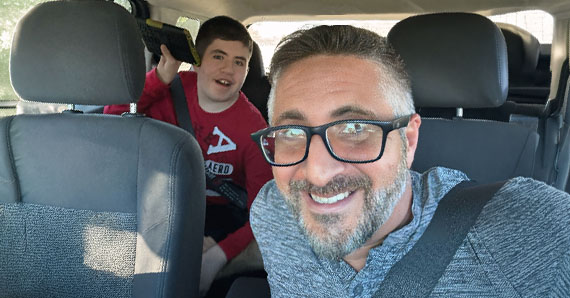
On the surface, I get it. I understand how people might think it is next to impossible to have a relationship with a nonverbal child who has severe autism.
Not only can I take myself out of my own shoes and watch my life from another point of view, but there was a time when I didn’t have a child like Lucas.
There was a time when I was the person watching from across the supermarket aisle. I saw mothers and fathers with their children and had all sorts of thoughts.
I felt bad for the family. In my mind, this was an issue that was almost insurmountable. Their lives, from my perspective, were filled with chores, responsibilities, and a lack of understanding.
Today, I’m the father of a 15-year-old young man who has profound autism and has never spoken a word. My life has chores, responsibilities, and, yes, a lack of understanding.
It is not, however, filled with those things.
Rather, they’re a part of our lives. All three are fair characteristics. All three, though, are also fair characteristics of any parental situation.
My neurotypical daughter brought chores and responsibilities. In terms of lack of understanding, it’s pretty safe to say that dealing with any teenager brings those moments too.
Yet, just like my son, those moments are a part of the bigger picture. With Olivia, there is more love, acceptance, and true understanding than anything negative.
The same can be said for Lucas.
Ironically, the same ways in which I build that bond with my girl are the same ways I’ve done it with my boy. It’s so simple that it almost feels silly to write. It’s a statement we all need to take to heart in order to connect with anyone.
I listen. I observe. I understand.
That’s it. As a parent, you figure out early on to pay attention to different aspects of your children. It’s not what they say, but how they say it. Sometimes it’s about what they’re not saying. It’s about a look. It’s about the silence. It’s about noticing the little things.
This starts when they’re babies and continues through life. When Olivia calls me from school, I can usually tell right away if she’s OK by the tone of her voice or the way she’s communicating. It’s been like that since she was an infant.
While that continues through life, it’s easy to overlook. After all, she’s changed as she’s grown. Deciphering her nonverbal cues can sometimes be overshadowed by the words she says and the way her life has evolved.
Lucas has no words. In a lot of cases, my understanding of him today is similar to how it was when he was little. It’s not about the words he says, because he doesn’t have any actual words.
Instead, it’s about his mood. It’s when his facial expression changes. A clapping cheer that usually means happiness can mean the opposite when his eyes are scrunched up in frustration. A kiss to my cheek, often gentle, means something else when he’s pressing it into my face with full force.
I’m his dad. A dad knows.

How do I know? I know because I pay attention. I’ve learned who my boy is through the years by watching him closely. I accept that everything he does has meaning. His sounds, reactions, and screeches are never “just autism.” They all mean something.
That refusal to dismiss him out of hand as simply “being fussy” is what has built the relationship we have today. He knows that I will never shoo him away. I get him and, perhaps more importantly, he knows I get him.
This has been an important aspect of our dynamic. If Lucas comes to me and asks for pizza with his device, he might not get it every time. But he knows one thing…
He knows I understand him.
There are times when I might give it to him right away. There are other times when I make him wait. During those times of denial, he knows that he’s communicated his wants and, even if I tell him to come back soon, he knows he’ll eventually eat.
That’s huge.
I could never imagine being hungry and not knowing if those entrusted to feed me will understand. I would probably have a meltdown in those situations too.
Lucas doesn’t have meltdowns with me during those times because he trusts me. He knows I get it. He knows I’m listening.
All of that goes back to observing. Showing Lucas that I care enough to pay attention has been the foundation of our relationship. He doesn’t need me to understand every single thing he does. He just needs to know that I’m trying.
And that’s something I’ve carried into every relationship in my life.
I used to look at families like mine and wonder how they could possibly connect with a child who couldn’t speak. I assumed there was something missing. Something that made their relationships fundamentally different from the ones I understood.
Now I know better.
My son has never said my name. He’s never told me he loves me. He’s never asked me how my day was or told me about his.
But I know when he’s happy. I know when he’s frustrated. I know when he wants to be left alone and when he wants me right beside him.
And he knows me, too.
He knows when I understand him. He knows when I’m listening. He knows that when he comes to me with something to say, even without words, I’m going to pay attention.
Fifteen years ago, I might have looked at a father and son like us and wondered how they could possibly have a relationship.
Today, I can’t imagine how we couldn’t.
Looking for a speaker who talks about parenting, connection, and reframing expectations?
You can book James Guttman here.
If this story resonated with you, I talk more about topics like these on
Hi Pod! I’m Dad.
READ NEXT: I Love My Gross Cats
Follow Us on Facebook, TikTok, and Instagram.


You must be logged in to post a comment.