
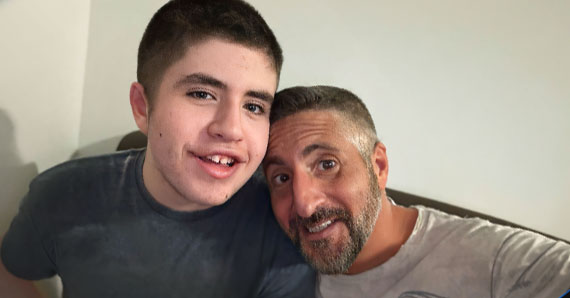
For a long while, I only had one item on my checklist when it came to teaching my nonverbal son the skills he needed for life.
Language.
It felt like an obvious issue and the only one that needed “fixing”. I remember thinking that to have my son unable to speak would be the worst possible scenario. Everything and anything went back to getting those words from him.
If a teacher asked for a list of things to work on, “speaking” was the top ten out of ten. In hindsight, it was tunnelvision. Actually, even then I knew it was tunnel vision. I didn’t care.
To me, nothing else was as important. This had to be our only priority.
The issue with that is that there was a real chance that he might not be able to form words. Whether it’s physical or mental, there was some sort of barrier that could make it impossible for Lucas to communicate the way that society deems appropriate.
That was a realization that hit early. I knew that there was a chance he might never have the skills to make verbal language a reality. But, if there was a chance, I wanted to work on it. To this day, I still do.
Being the parent to a nonverbal child can be incredibly frustrating. The frustration extends beyond my son.
You feel like you’ve failed. You feel judged. You feel like the world is looking at you as if you weren’t able to properly raise your baby into a kid.
Forget the fact that I already had a child who spoke at an early age. Forget the fact that I spoke to Lucas every single day since he was born. Forget the fact that I did nothing different than any other parent would do. Some people would still give a judgmental opinion. In fact, some still do.
Nothing felt more important than getting him to talk. It was as if my house was on fire and teachers wanted to help him learn to wash dishes and fold clothes. I remember thinking it was ridiculous to focus on anything except getting my now-three, four, or five year old to say his literal first words.
When that true moment of acceptance hit for me, everything pivoted. Our world changed on the day I finally told myself, “I can teach him, but he might never be able to do this in the way I envision. Maybe I should work some other skills into the rotation.”
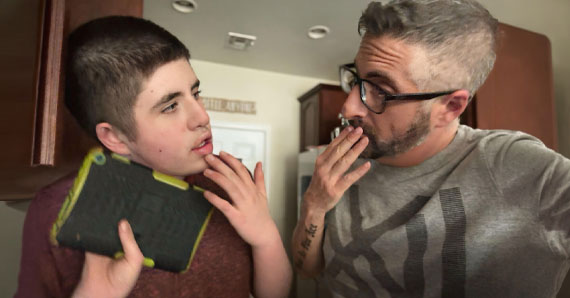
From there, we started on a barrage of life skills that, to this day, has been a vital part of learning for Lucas. From putting on his socks to brushing his teeth, there has been so much to work on. Every day, we still do.
It takes time and patience. You have to, as a parent, be willing to take a chore that might take two minutes with my help and allow him fifteen to try on his own, often needing to be redone. Anyway.
To this day, I will watch him fiddle with a sock for an extended period of time. Eventually, when he gets it on, I applaud and tell him he did a great job.
Then I take it off and put it back on correctly. That’s how teaching a child like mine works.
Sure, I can collect his dirty dishes. It would take ten seconds to clear his place. But no, I have him bring his plate to the sink himself.
I then vacuum all the crumbs he got on the floor when he held the plate vertically. Again, more time, but it’s all about the learning.
Still, though, it can feel like I have that early tunnel vision. With a 15-year-old, complete with chest hair and beard stubble, the lack of life skills is like seeing my house ablaze yet again. Nothing should be higher on my list of priorities than this.
And there’s not. Just like getting him to speak – something we still practice today – teaching him to be self sufficient is a major task on our list.
It is not, however, our only task.
What other tasks are there? Everything. It’s up to me, though, to realize them.
I talk often about how the key to raising a child like Lucas is to pay attention. I mean it in so many ways. From forming communication to building a bond, being observant of Lucas is the most important part of making him a complete person. Sometimes you don’t even know what he doesn’t know until you really think about it.
Case in point – pockets.
On Friday, while getting him ready for school, I noticed his finger caught on his pants pocket. I saw this and, to my surprise, I realized that this kid has never dealt with pockets.
I couldn’t remember ever introducing him to the concept of what they were or why we have them. I mean, how would that even come up?
So, I began the pocket lesson. I placed his hand in his pocket and, although distracted, he went along with it. Each time he did, I enunciated “pockets’. I then put a tiny rubber duck that had been sitting nearby into his pocket and had him take it out. I narrated it all.
Where did the duck go, Lucas? It’s in your POCK-ET. Yes. POCK-ET. Can you get the duck from your POCK-ET.
And he did.
Will he remember this tomorrow? Doubtful. We only did it once. Will he remember it after the 20th time? Perhaps. That’s more likely.
But to get to the 20th time, we have to do it the first time. To do it the first time, I had to pay attention to things he doesn’t know, but might need to learn.
Pockets are just one of the many items on our things-to-do. I know that and accepted it a long time ago. It’s why tunnel vision is so detrimental to building a bigger picture. It’s why seeing major milestones as a house fire only burns down your opportunities to find and teach things that your child might be able to understand easier.
Will Lucas speak one day? I’m not sure. Will Lucas have all the life skills he needs to be completely independent? Again, I’m not sure.
But will he be the most well-rounded person he is capable of being? Absolutely.
If I simply pay attention and do my part, we have that in our back pocket.
Looking for a speaker who talks about parenting, connection, and reframing expectations?
You can book James Guttman here.
If this story resonated with you, I talk more about topics like these on
Hi Pod! I’m Dad.
READ NEXT: It’s 4:30AM, and I Just Learned Something About Autism Appreciation
Follow Us on Facebook, TikTok, and Instagram.


You must be logged in to post a comment.